A Walkway Suspended in the Rainforest’s Upper Storey
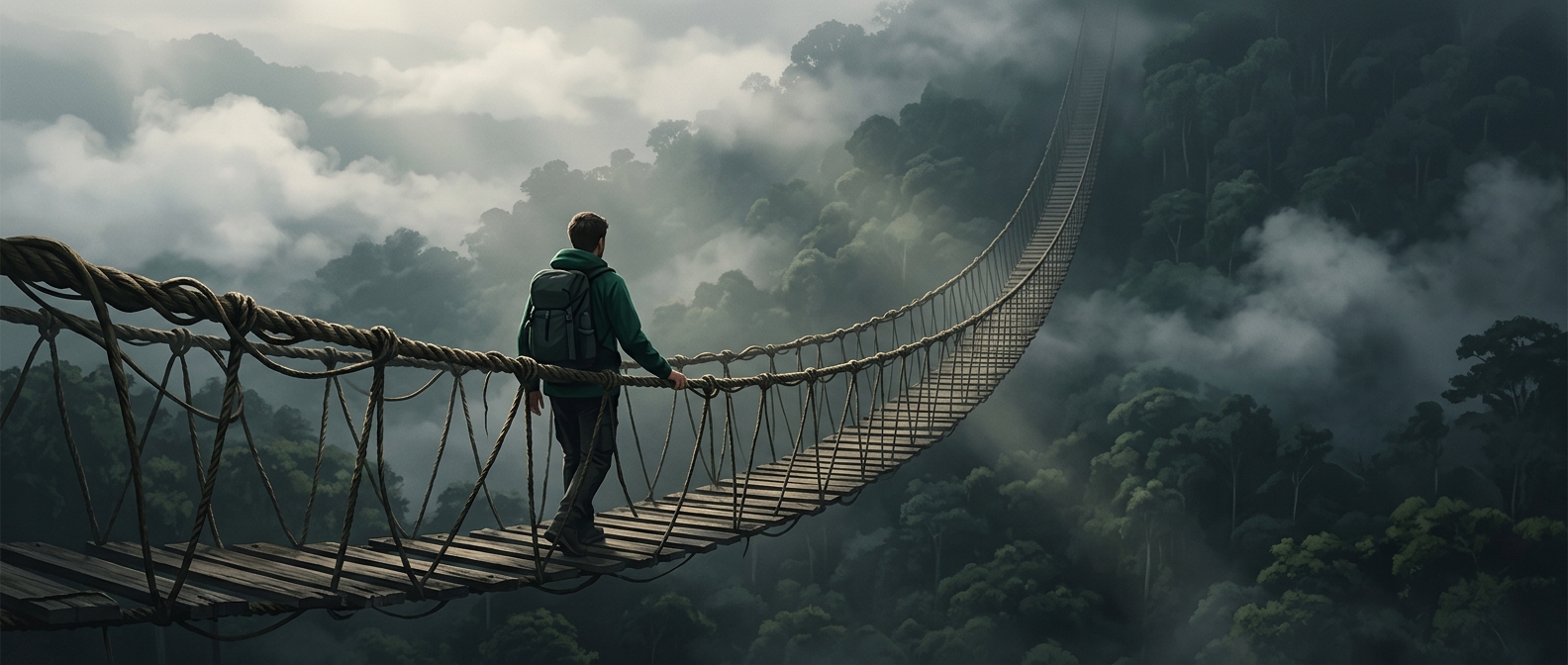
At Danum Valley, the rope bridge lifts hikers roughly 130 feet above the forest floor, into the canopy—the interlocking crowns of trees that form the rainforest’s upper layer. Rather than standing on a freestanding tower, the walkway is anchored to towering dipterocarp trees, whose trunks rise through the forest to support the bridge.
That arrangement makes the crossing feel different from a rigid platform. A suspended bridge can shift and sway as people move across it; the motion is part of walking on a flexible span hung between living trees. Below, the ground is far enough away that the bridge offers a view into a part of the rainforest most visitors would otherwise see only from below.
Why the Canopy Matters
The upper branches are not just a scenic vantage point. They are a route and living space for animals that spend much of their time in trees. Orangutans, for example, can travel through the canopy by moving among branches, so a hiker on the bridge may see them at roughly the same height rather than looking up from the forest floor. A sighting is never guaranteed, but the elevated path places visitors closer to the animals’ arboreal world.
The setting is described as a 130-million-year-old primary rainforest: forest that has remained largely intact rather than being extensively cleared and regrown. Crossing above it makes the scale tangible—the bridge is a narrow human-made line amid trees that have shaped this forest for an immense span of time.