A narrow strait with a deep past
The boundary is known as the Wallace Line, after naturalist Alfred Russel Wallace, who noticed a sharp change in animal life while exploring the Malay Archipelago in the 19th century. It runs through the islands between Bali and Lombok, then north between Borneo and Sulawesi. The islands look close on a map; their geological histories made them harder for land animals to cross.
During ice ages, lower sea levels exposed broad stretches of shallow seabed, joining some islands to the Asian mainland and to one another. But deep channels remained underwater. Land mammals could spread across the newly connected land, yet they could not simply walk across those channels. Even when islands were nearer together, a water gap could block animals that were poor swimmers or unable to survive a long crossing.
Two neighboring animal worlds
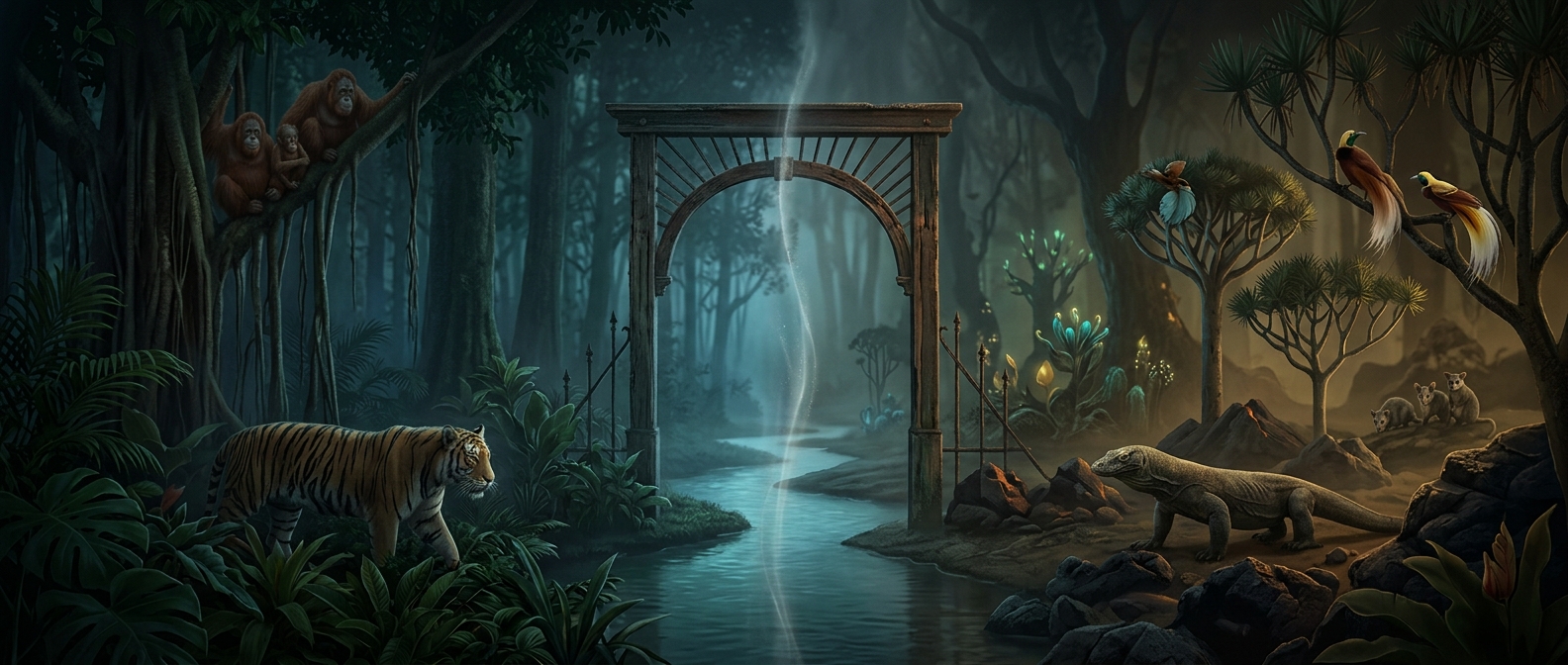
West of the line, many mammals have Asian affinities, including monkeys and tigers. Farther east, Australia and nearby islands have a stronger Australasian character, with marsupials—mammals that carry and nurse their young in a pouch—among the distinctive groups. The divide is not a perfect fence: animals can cross water, and the islands around it have their own mixtures and unusual species. Sulawesi, for example, has a fauna unlike either side’s familiar mainland mix.
The striking point is that proximity did not guarantee exchange. A deep channel that remained open through changing sea levels could preserve a biological divide for immense stretches of time. That is why a short sea crossing can mark a bigger boundary in nature than hundreds of miles of continuous land.