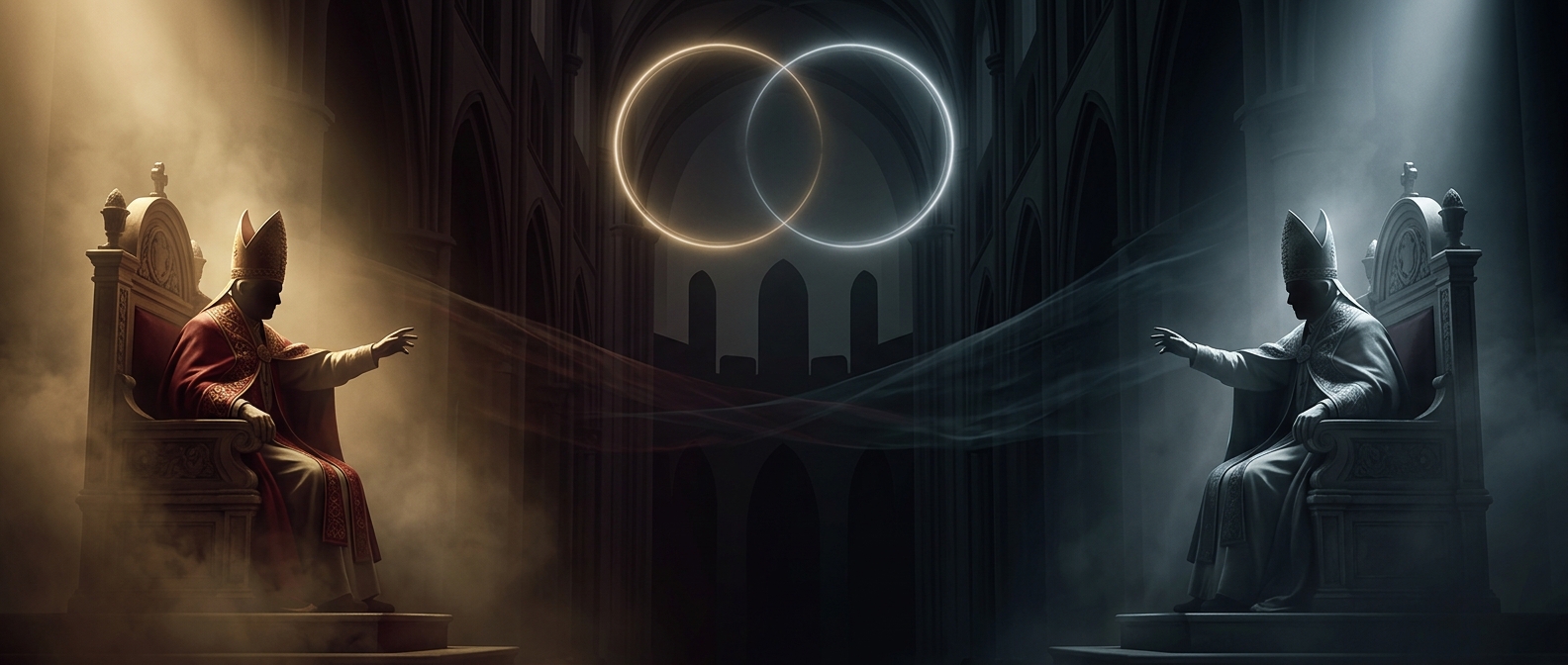
How a dispute over one election became three papacies
The crisis began in 1378, after the death of Pope Gregory XI. Cardinals in Rome elected Urban VI, but some soon said the election had been made under pressure from a Roman crowd demanding an Italian pope. They withdrew their support and chose Clement VII instead. Clement set up a rival court in Avignon, France, while Urban remained in Rome. Each side treated its own election as valid and the other man as an impostor.
That division, later called the Western Schism, split the Church’s loyalties. Rulers and clergy had to choose which claimant to recognize, and each pope could issue decrees and appoint church officials for his own supporters. Excommunication—the formal exclusion of a person from the Church’s sacraments and community—was one way to declare a rival’s claims illegitimate and warn followers away from him.
The attempted fix made the split worse
In 1409, church leaders met at the Council of Pisa to end the dispute. They declared the rival popes deposed and elected a new one, Alexander V. But the original claimants did not accept the council’s authority or step aside. Instead of replacing two claimants with one, the council left three competing papal lines: those of Rome, Avignon, and Pisa. After Alexander’s death, John XXIII became the Pisan claimant.
Each claimant could still impose church penalties on his opponents, but a sanction could not make the wider Church agree about who had the right to issue it. Excommunication was powerful only when people recognized the authority behind it. With three rival claimants condemning one another, the penalty exposed the very problem it was supposed to resolve: there was no universally accepted pope to settle the question.