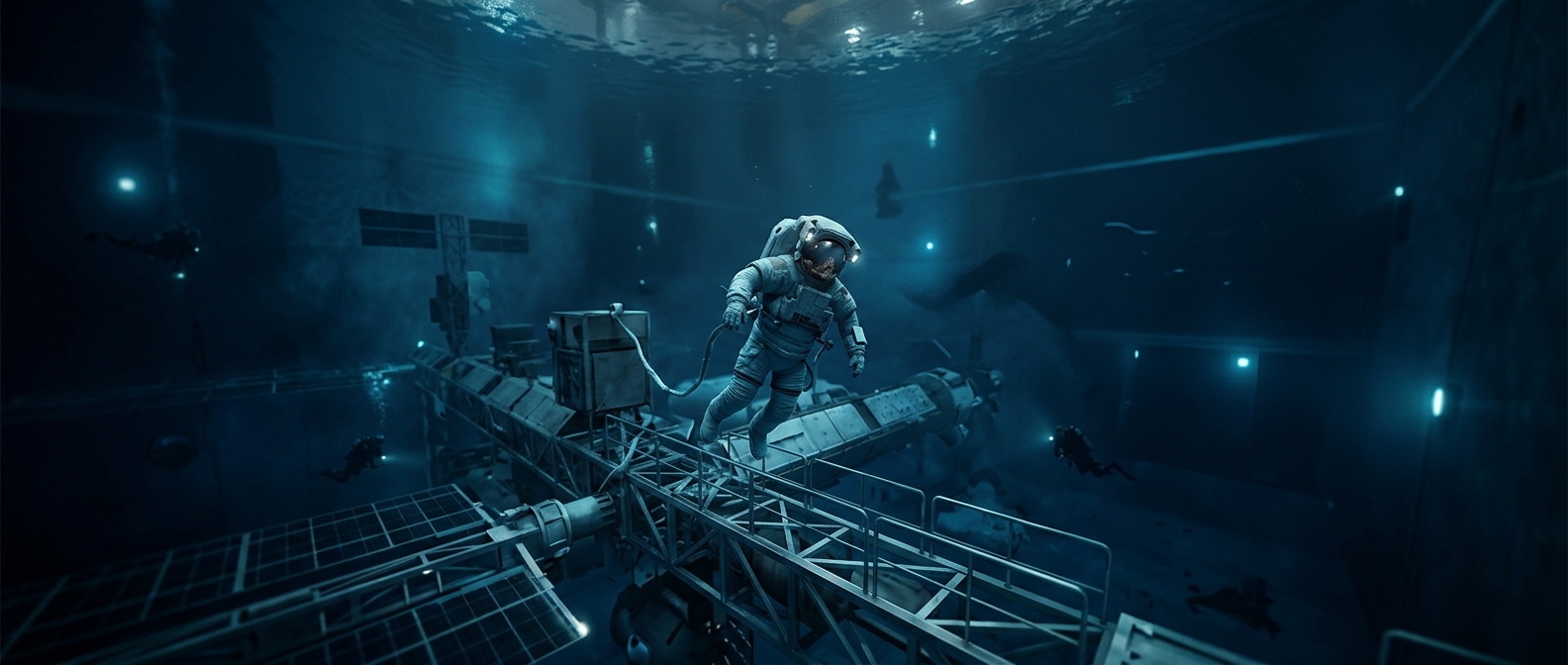
How a Pool Rehearses a Spacewalk
NASA’s Neutral Buoyancy Laboratory uses a huge indoor pool to let astronauts practice working outside a spacecraft. Full-size mock-ups of space hardware sit underwater, where crews can rehearse tasks such as handling tools, moving along a structure, and responding when a procedure takes longer than expected. The goal is not simply to get used to wearing a spacesuit; it is to practice the work in a setting where ordinary walking and standing are impossible.
Buoyancy Cancels Much of the Weight
A spacesuit is bulky and heavy on Earth. Underwater, carefully adjusted flotation weights make the suited astronaut nearly neutrally buoyant: the water’s upward push roughly balances the pull of gravity. The astronaut can then remain suspended near a worksite rather than being pulled down to the bottom, creating a useful approximation of weightlessness.
That balance is not the same as floating freely in orbit. Water still surrounds the astronaut and pushes back against movement. Its drag slows a reaching arm, resists a turn, and makes repositioning unlike the effortless motion of an object drifting through space. In orbit, there is no water to provide that braking force.
Practice Includes the Friction of Working
The resistance is a limitation, but the pool offers something difficult to reproduce in a spacecraft: a large, accessible place to rehearse a sequence repeatedly. Astronauts can work through complicated tasks around realistic equipment, while instructors observe from above and divers help maintain safety. Rehearsal also reveals how a small movement can affect the body’s position and the tools or hardware nearby.
Because underwater motion is not a perfect copy of motion in orbit, pool training is one part of preparation, not a substitute for spaceflight. Its value is practical: crews can learn the layout, coordinate their movements, and refine a procedure before attempting it outside a spacecraft, where a misplaced handhold or delayed step is much harder to correct.