How a sphere can become two
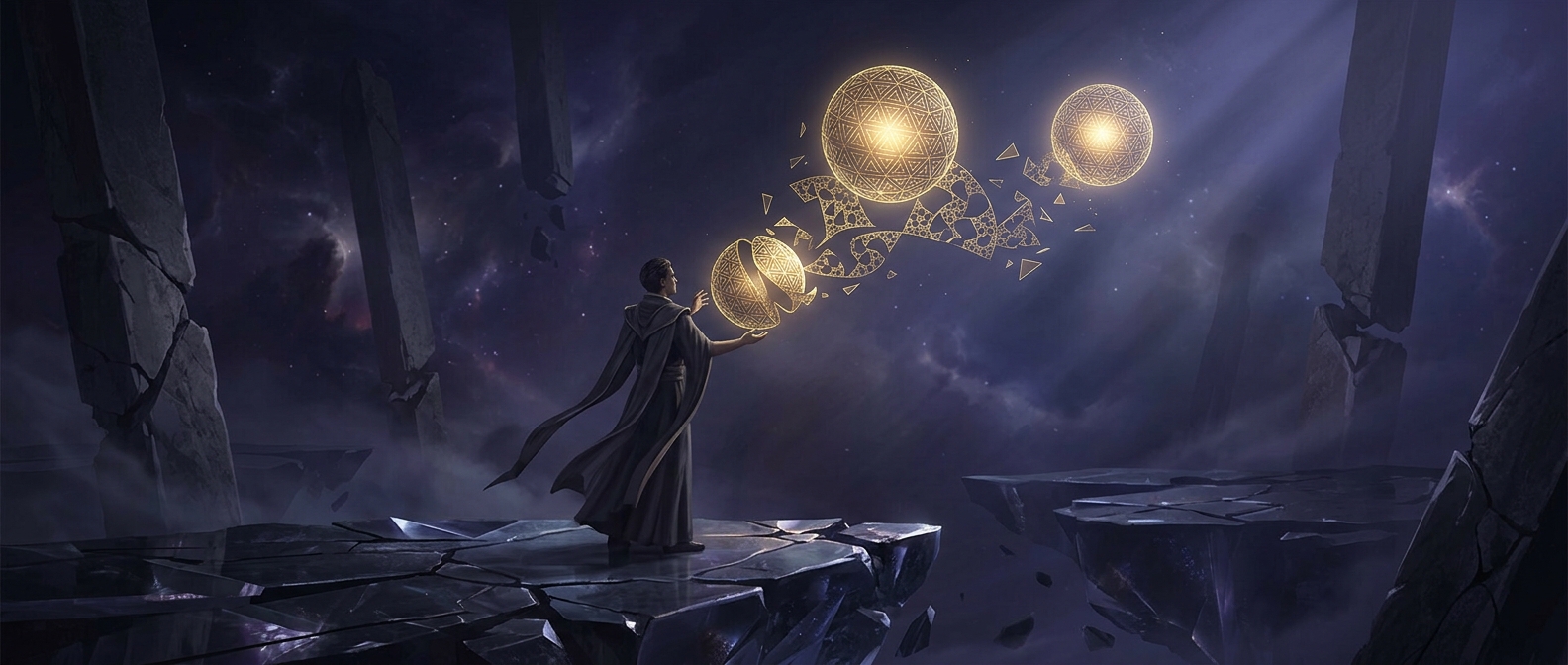
The Banach–Tarski paradox is a theorem about a solid ball in three-dimensional space. It says the ball’s points can be divided into a finite number of sets, then moved using only rotations and translations, and assembled into two balls identical to the original. The pieces do not stretch or change size during the moves.
The catch is what counts as a “piece.” These are not chunks with smooth surfaces. Each is a scattered collection of individual points, spread throughout the ball in a way that cannot be cut out, handled, or even described by ordinary measurements.
The hidden role of volume
For everyday objects, volume is preserved when pieces are moved around. If you cut an orange into chunks and rearrange them, their volumes still add up to the orange’s original volume. That reasoning assumes each piece has a well-defined volume.
The paradoxical sets do not. They are nonmeasurable: mathematical volume cannot be assigned to them in a way that behaves consistently with the familiar rules for measuring solid shapes. So adding their “volumes” cannot expose a contradiction; there are no such volumes to add. The theorem does not create matter. It shows that ordinary volume intuition has limits when applied to unusually constructed sets of points.
Why the pieces are so strange
The construction uses rotations of a sphere and the way different sequences of rotations can combine. In three dimensions, those rotations have enough structure to divide points into collections that can be rearranged to reproduce the whole ball more than once. Selecting the required collections relies on the axiom of choice, a principle in set theory that permits certain selections without giving a concrete recipe for making them.
That is why the result is mathematically valid but physically impossible to perform. A real blade can cut only regions with workable boundaries, and real materials have measurable volume. The doubling happens in the abstract world of point sets—not in a workshop.