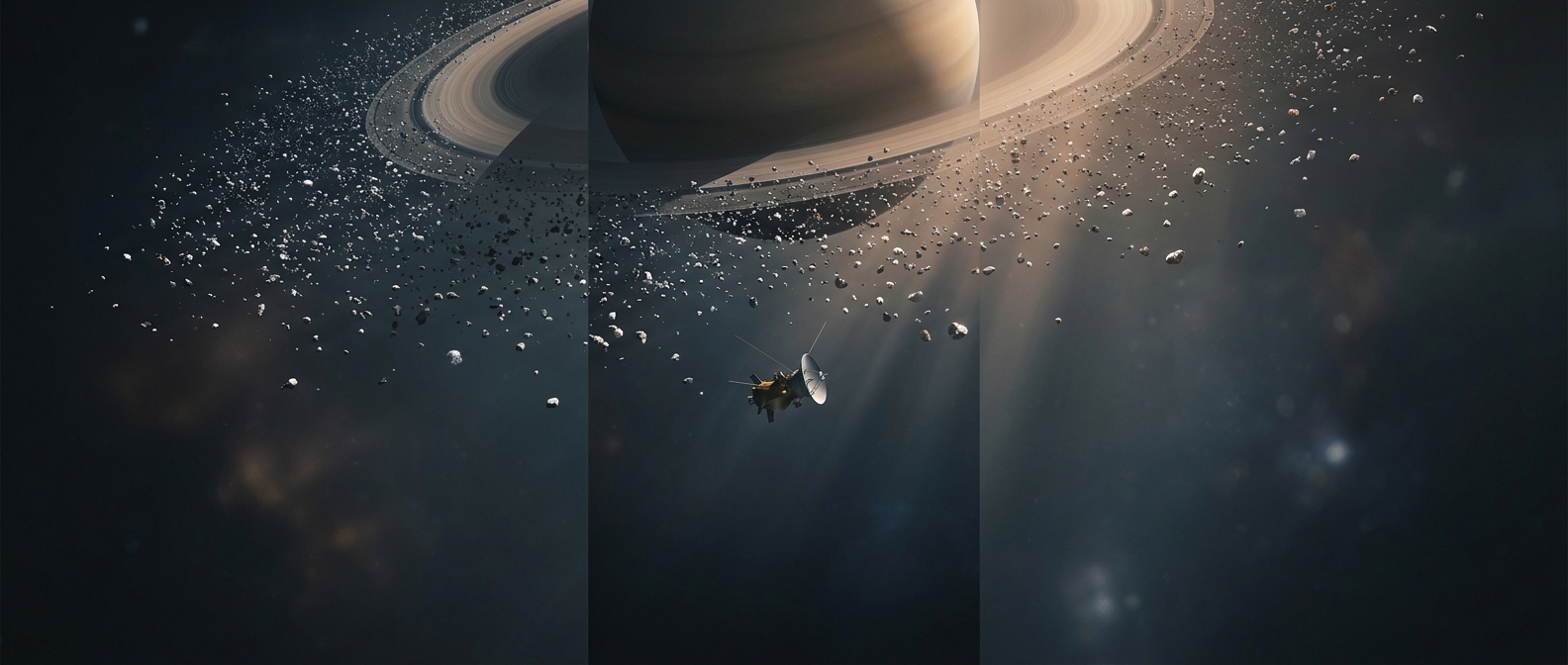
How Saturn’s rings can look solid from far away
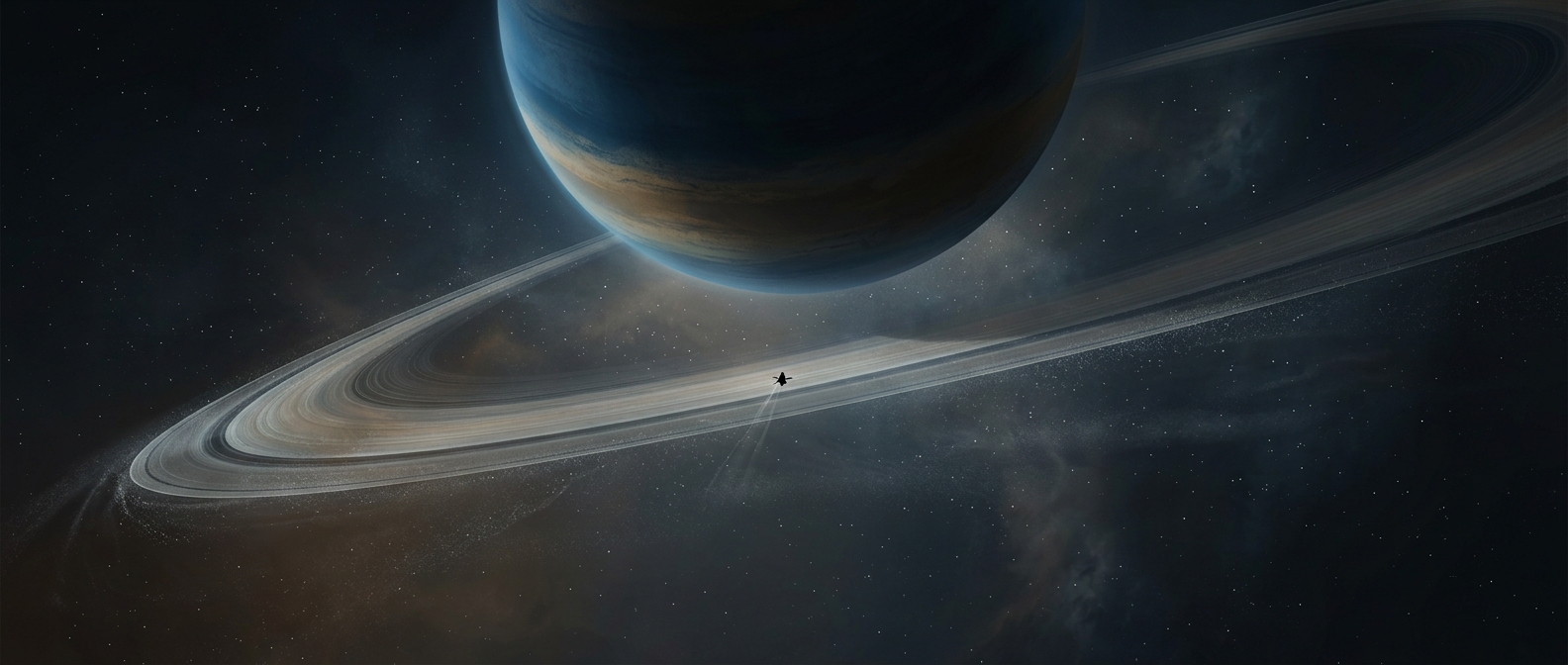
Through a telescope, Saturn’s rings appear like smooth, continuous bands. Up close, they are made of countless separate particles, from dust-sized grains to chunks of ice and rock. The gaps between them are enormous compared with the particles, but from a distance the pieces blend into a bright sheet.
That appearance raises a puzzle: if the rings are loose material, why do some bands have sharp edges and clear gaps?
A moon can reshape the traffic
A moon orbiting near a ring can tug on ring particles with its gravity. The effect is especially strong for particles whose orbits repeatedly bring them into a particular alignment with the moon. Each encounter adds a small gravitational nudge; over many orbits, those nudges can change the particles’ paths enough to move them out of that region.
The result is not a moon plowing a clean trench through the rings. It is closer to a lane organizer: gravity gradually steers particles away from certain orbits, helping create or maintain a gap. Other gravitational interactions can also shape ring structure, so a visible gap is not simply an empty groove carved in one pass.
What Cassini changed
Before spacecraft observations, the rings’ smooth appearance could encourage the impression of a solid structure. Cassini’s close study of Saturn revealed the rings as a dynamic system of many individual pieces, with moons and particles continually influencing one another.
That changes how the rings are understood: their crisp patterns are not markings on a fixed disk, but outcomes of countless small orbital motions. A moon can leave its mark without touching the material at all—by repeating the same gravitational tug until the traffic shifts.