From separate sightings to one orbit
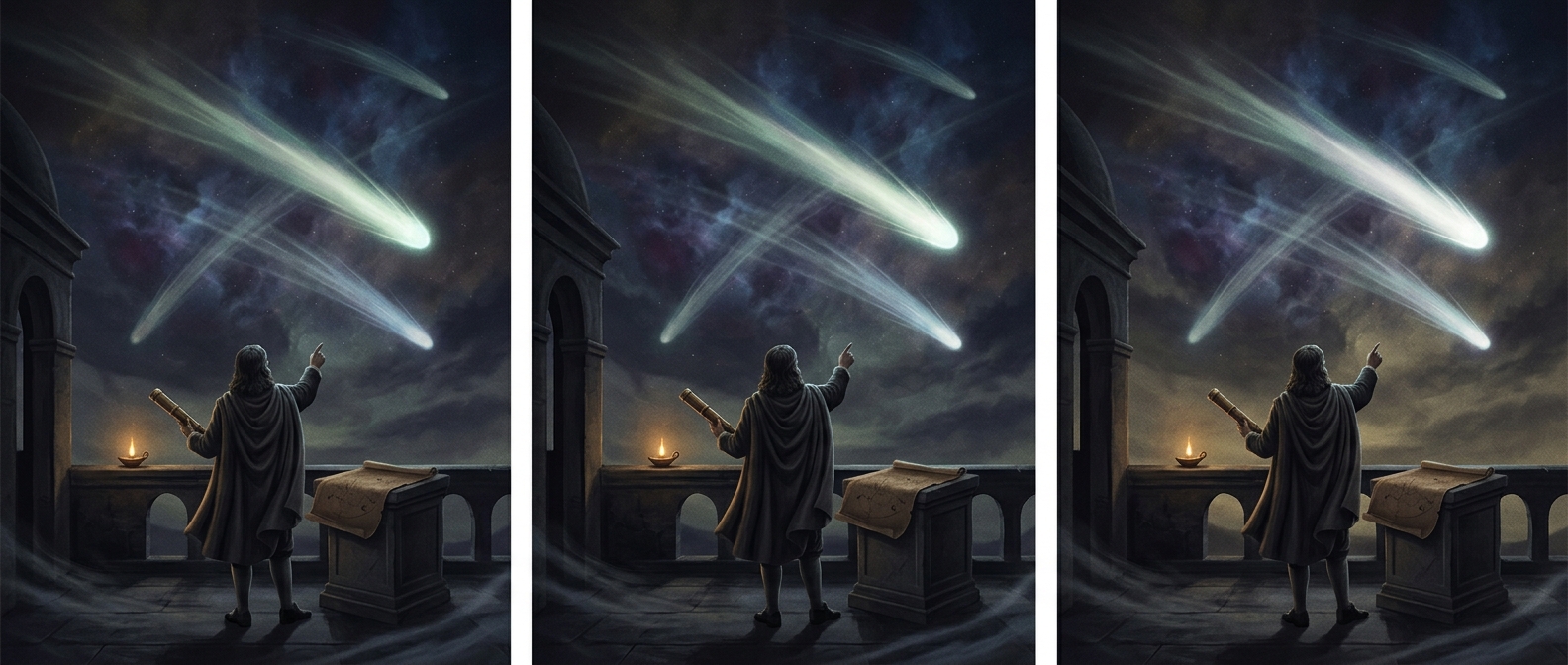
A comet’s appearance is brief, but its path across the sky can be recorded and compared with earlier observations. In the early 18th century, astronomer Edmond Halley examined reports of comets seen in 1531, 1607, and 1682. Their routes and orbital shapes were strikingly similar. Rather than treating them as three unrelated events, he proposed that they were the same object returning on a long loop around the Sun.
That was a bold inference: no one had yet watched the comet complete a full return. Halley used Isaac Newton’s new theory of gravity to make sense of the observations. Under that theory, a comet can follow an elongated orbit, spending most of its time far from the Sun and becoming visible again only when it swings back inward.
A prediction tested by time
The intervals between the three recorded appearances suggested a return after roughly three-quarters of a century. Halley therefore predicted the comet would come back around 1758. Its timing was not perfectly predictable: the gravity of giant planets such as Jupiter and Saturn can tug a comet away from the path it would follow under the Sun’s pull alone.
Halley died before the predicted return. Astronomers spotted the comet again in late 1758, and it passed closest to the Sun in 1759. That arrival turned a pattern in old records into a successful forecast—and gave the comet the name by which it is now known.
The key shift was seeing a comet not as a one-time spectacle, but as a member of the solar system with a trackable orbit. Its long absence was part of the journey, not evidence that it had vanished.