Why the Middle Ear Needs a Mechanical Link
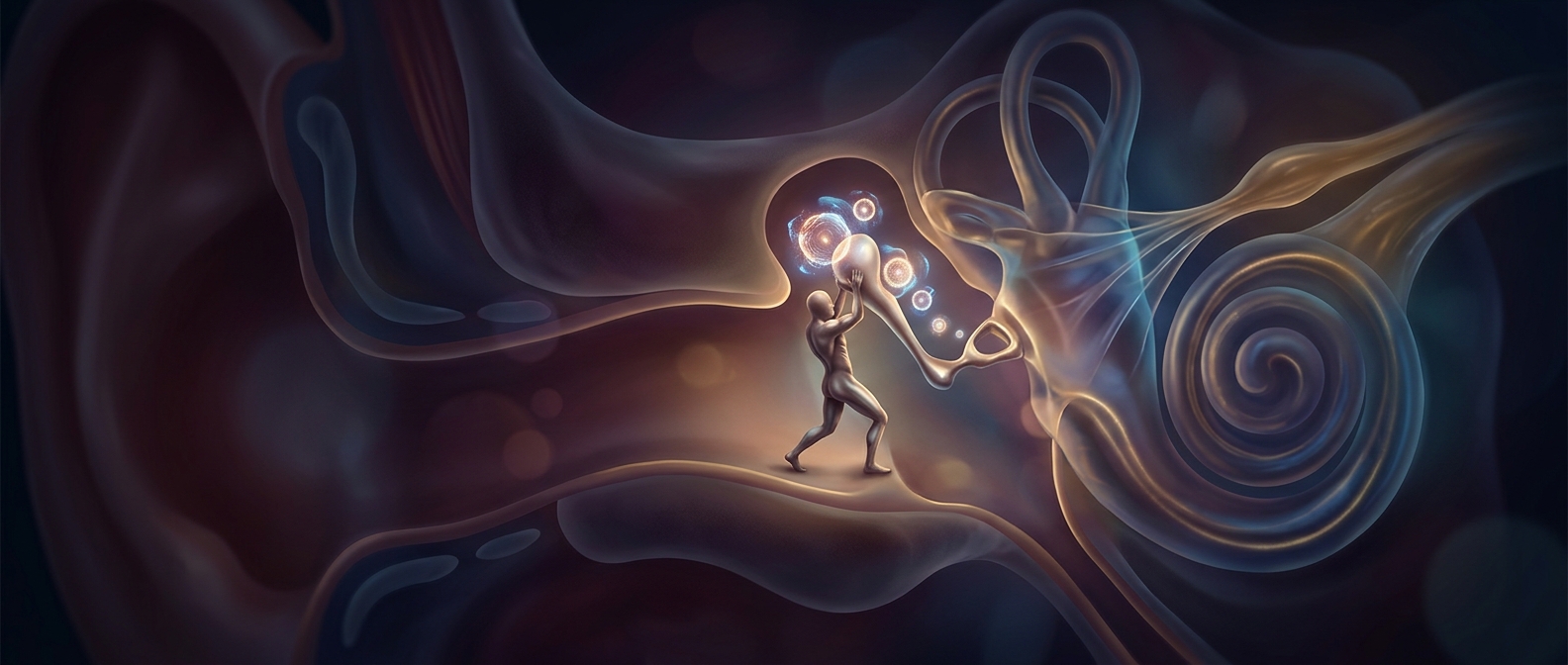
Sound travels through air as pressure waves, but the inner ear is filled with fluid. If those waves simply struck the fluid directly, much of their energy would bounce away at the boundary, like a sound that fails to pass efficiently from air into water. The middle ear solves this mismatch with three small connected bones: the malleus, incus, and stapes.
The eardrum’s motion moves the malleus, which pushes the incus; the incus then rocks the stapes. This chain carries vibration across the air-filled middle-ear space and delivers it to the oval window, a flexible opening into the fluid-filled cochlea.
Turning Motion Into a Useful Push
The bones do more than pass vibration along. Their lever-like movement, together with the difference between the broad eardrum and the much smaller oval window, concentrates force onto that opening. The result is greater pressure at the cochlea than the eardrum could produce by itself. This impedance matching—helping energy pass between materials that transmit vibration differently—makes hearing more efficient.
At the oval window, the stapes pushes and pulls the cochlear fluid. That movement creates waves inside the cochlea, bending tiny sensory hair cells. The cells convert the bending into electrical signals that travel through the auditory nerve to the brain, where they are interpreted as sound.
A Small Bone With a Delicate Job
The stapes must move freely enough to transmit ordinary sound vibrations. If the chain becomes stiff or its motion is restricted, less energy reaches the cochlea and hearing can be reduced. Its size is therefore not a measure of its importance: this tiny piston is the final mechanical step that gets airborne sound moving through the fluid where hearing begins.