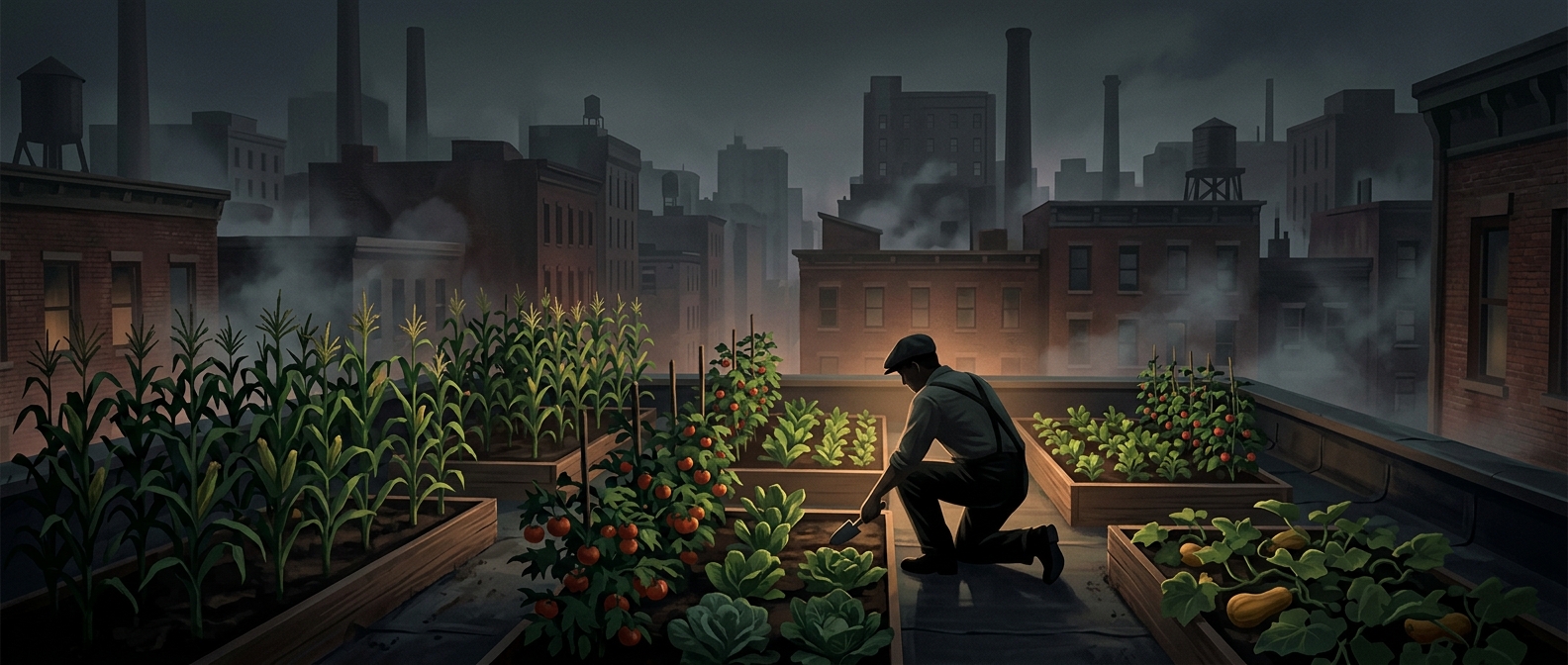
Turning a Roof into a Patch of Ground
For a family short on food and money, a flat roof offered something rare in a crowded city: open space with direct sunlight. A few beds or containers could produce vegetables close to home, without the cost of renting a plot or traveling to one. The roof was not naturally farmland. Soil had to be carried or contained above the street, and plants needed regular water, so even a modest garden required work and access to the building’s upper level.
A Practical Use of Limited Space
The Depression made household food production more urgent as incomes fell and jobs disappeared. Growing vegetables could not replace a full supply of groceries, but it could add fresh produce to meals and make an otherwise idle surface useful. Rooftops also offered an advantage over many street-level spaces: they were less exposed to foot traffic and competition for ground in dense neighborhoods.
Not every roof could safely support a garden. Wet soil is heavy, and buildings differ in what their roofs can bear; water also had to be hauled or brought up somehow. The gardens therefore depended on suitable roofs and the effort of residents, rather than turning every city building into a farm.
Their significance lay in that small-scale ingenuity. A surface built to shelter people could also help feed them, making unused space part of a household’s response to scarcity.