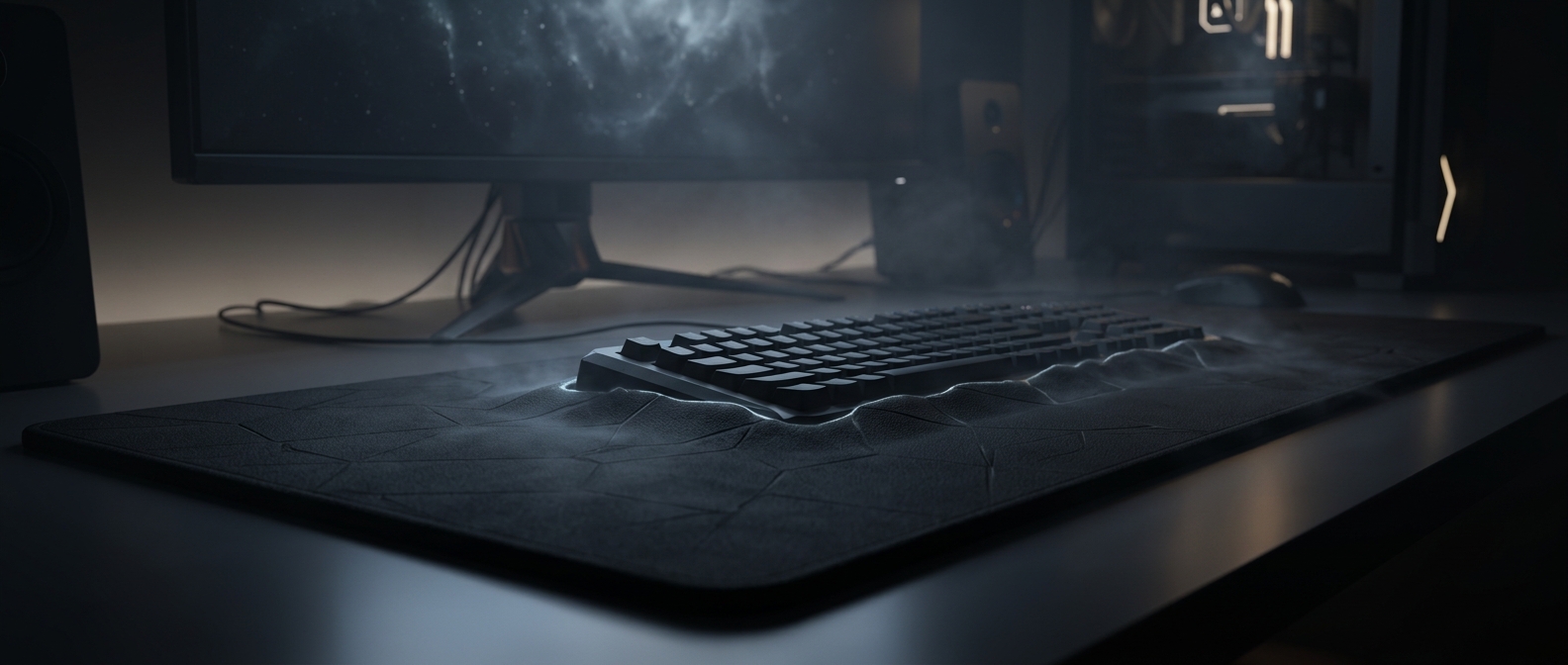
Why a desk mat can steady a keyboard
Typing is not purely a downward motion. Fingers press keys at slight angles, and quick repeated taps can nudge a lightweight keyboard sideways or forward. A plastic keyboard has little mass, so those small pushes may be enough to make it creep across a smooth desk.
A desk mat adds a different surface beneath it. The keyboard’s feet press into the mat, and friction—the resistance between surfaces sliding against each other—helps oppose each sideways push. Many mats also have a grippy underside that resists movement against the desk, so the keyboard and mat are less likely to shift together.
More than extra room for a mouse
A larger mat gives the keyboard a broad, continuous area to sit on while leaving space for mouse movement. It can also keep the keyboard from straddling surfaces with different heights or textures, which might make its feet less stable. The effect depends on the mat’s materials: a smooth keyboard bottom on a slick mat may still slide, and a mat with a poor desk grip can move as a whole.
The useful detail is that the mat works as part of a contact chain: keyboard to mat, then mat to desk. When both connections resist sliding, ordinary typing is less likely to send a lightweight keyboard wandering across the tabletop.