How a Mime Makes Empty Space Feel Solid
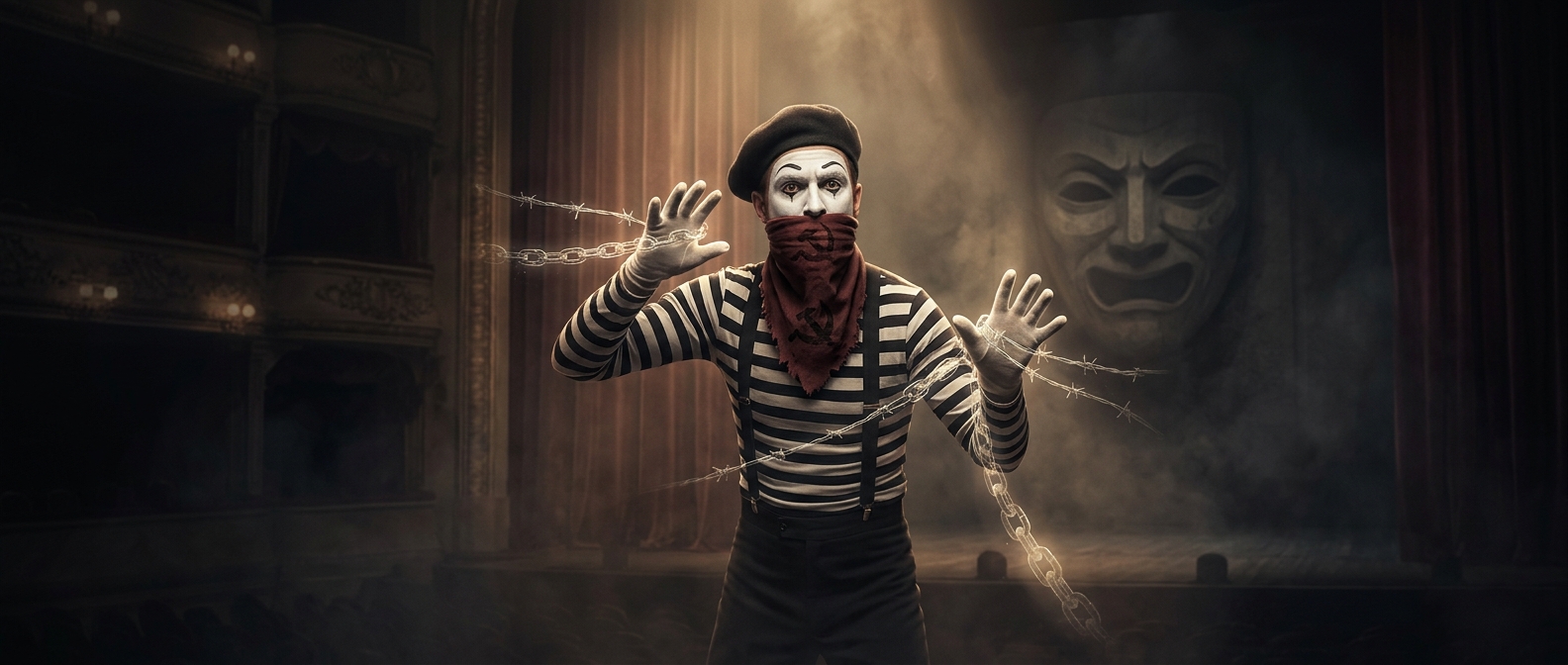
A mime’s invisible wall works because the performer gives it consistent boundaries. The hand meets the “surface” at the same height and place each time; the wrist stops instead of drifting through. When the performer leans into it, the rest of the body responds too: shoulders tense, feet plant, and the torso tilts as if an unseen force were pushing back.
That coordination supplies the evidence the audience needs. A hand alone can look like a gesture, but a whole body adjusting to resistance suggests a cause. The wall is imagined, yet the performer’s effort makes its effects visible.
Consistency Does the Heavy Lifting
Mime relies on the audience remembering where an object or boundary was. If a performer traces a box’s edge, then reaches for it again, the hand should return to the same invisible corner. If that point shifts, the imagined object seems to move—or disappear. Small, repeatable details preserve the illusion: a palm stays flat against a wall, a step stops at its edge, and a push produces strain rather than a casual wave.
The performer also has to keep the illusion legible from the audience’s viewpoint. A precise pause at the moment of “contact” gives viewers time to read the resistance. Too little reaction, and the wall feels weightless; too much, and the effort can look like a joke rather than an encounter.
The Audience Completes the Scene
These choices turn movement into a kind of silent storytelling. Viewers infer the wall from the performer’s posture and from the way one action leads to the next. The box feels real not because the air changes, but because the body behaves as though it has rules—and keeps obeying them.