A face can be a useful pattern
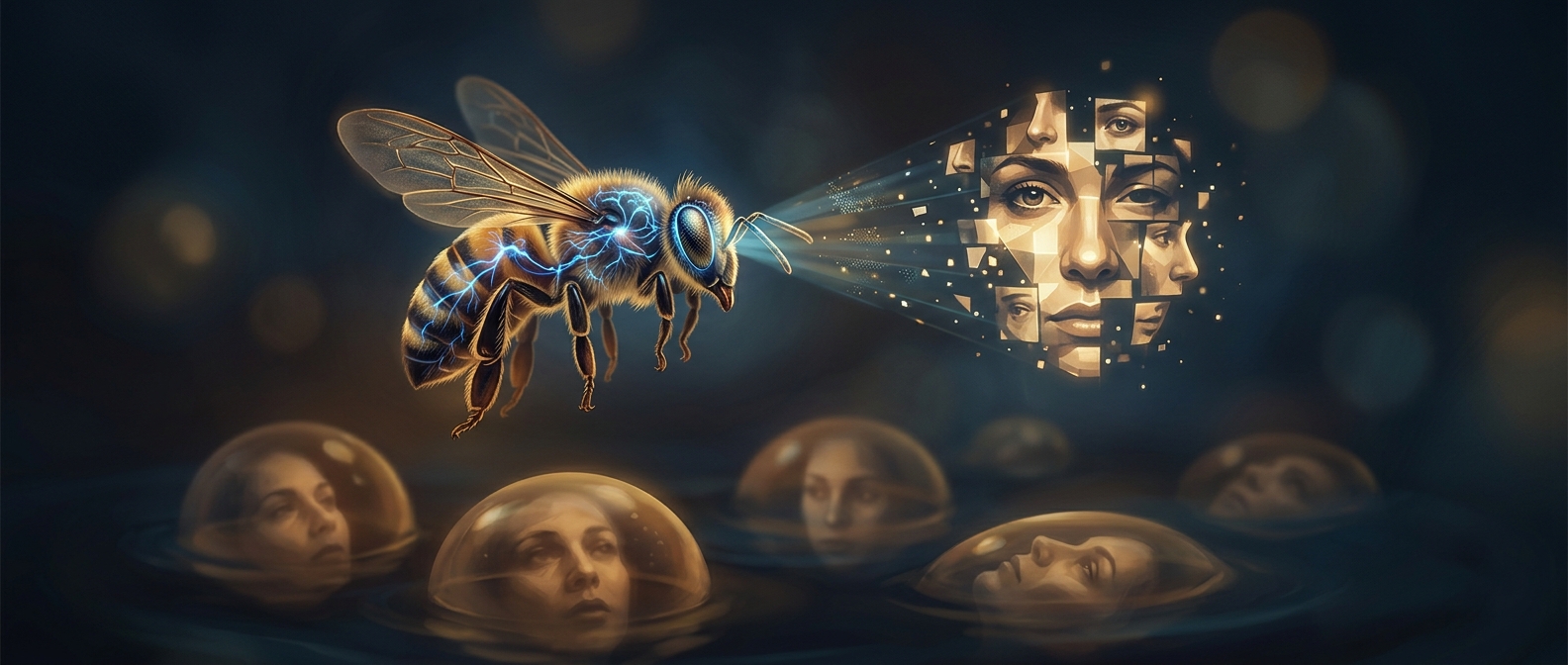
For a honeybee, a human face is not necessarily a collection of familiar features. It can instead be a visual arrangement: dark marks in roughly the right places, with one feature above another. Bees have compound eyes made of many small visual units, and they are adept at detecting contrasts and shapes—useful abilities when navigating among flowers and other objects.
In a face-learning task, the bee encounters several images and receives a reward for choosing one arrangement. With repeated practice, it can associate that visual pattern with the reward and select it again when other images are offered. The important step is learning which combination of visual cues predicts a payoff.
Learning a layout is not knowing a person
This is a form of associative learning: the bee links what it sees with what happens next. It does not require the bee to understand that the image is a face, or to identify the person depicted. The bee may be responding to the relative positions of dark and light areas rather than interpreting eyes, a nose, and a mouth as human features.
That distinction matters because a successful choice can look surprisingly human from the outside. The experiment shows that a small-brained animal can learn and remember a complex visual arrangement. It does not show that bees recognize individual people in the familiar social sense. A bee can learn the pattern that leads to a reward without knowing who the face belongs to.