Four ghosts, four different targets
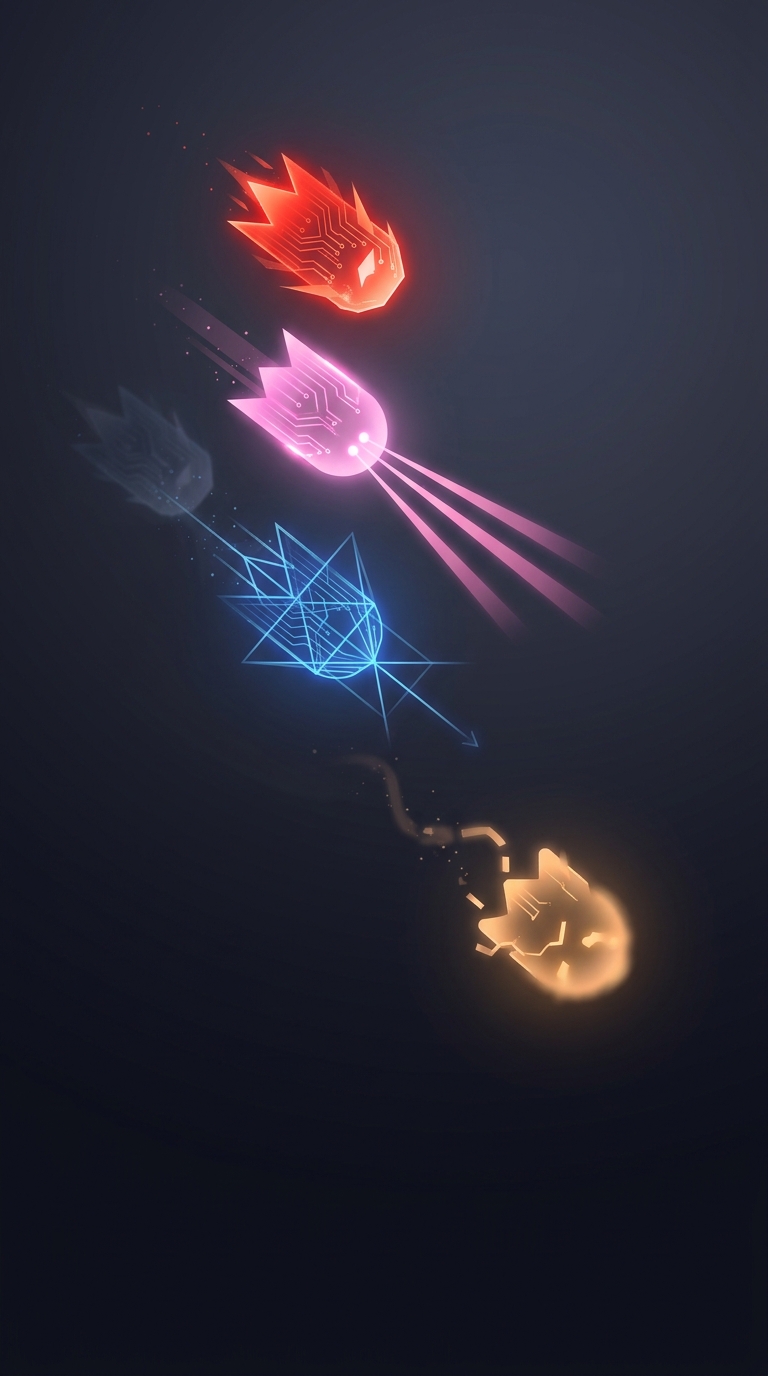
The original Pac-Man does not give its ghosts a shared instruction to “chase the player.” Each ghost uses a different rule to choose a destination on the maze’s grid. At intersections, it picks a legal turn that brings it closer to that target, so its movement can look purposeful even though it follows a simple, fixed protocol.
Blinky, the red ghost, aims directly for Pac-Man’s current position. Pinky tries to get ahead by targeting tiles in front of him. Inky’s target depends on both Pac-Man’s position and Blinky’s, making its approach less predictable. Clyde pursues Pac-Man when he is far away but heads toward his corner when he gets close.
How separate routes become a trap
Those rules make the ghosts dangerous in combination. Blinky can close from behind while Pinky tries to intercept the route ahead; Inky may approach from another angle, and Clyde can fill space near the maze’s lower-left corner. Their paths are not coordinated by a single planner, but the different targets can still surround Pac-Man and narrow his escape options.
The game also switches ghosts between chase and scatter modes. In scatter mode, each heads toward a designated corner rather than pursuing Pac-Man. That brief change can pull a ghost away from a corridor—or send it across a route Pac-Man hoped to use. When a ghost is frightened after Pac-Man eats a power pellet, its movement changes again.
Predictable does not mean harmless
Because the rules are fixed, experienced players can learn how a ghost is likely to react to a position. But the maze, timing, and overlapping routes make that knowledge hard to use perfectly. The ghosts feel like a team not because they think together, but because distinct, readable behaviors can create a shared effect: closing off the paths Pac-Man needs.