The twist begins at the inlet
A vortex tube, also called a Ranque–Hilsch tube, starts with air that has already been compressed by an external compressor. The air enters through angled nozzles near one end, which send it racing around the tube’s inner wall rather than straight down its center. That fast spiral creates a rotating flow with strong differences in speed, pressure, and temperature across the tube.
One stream divides into two
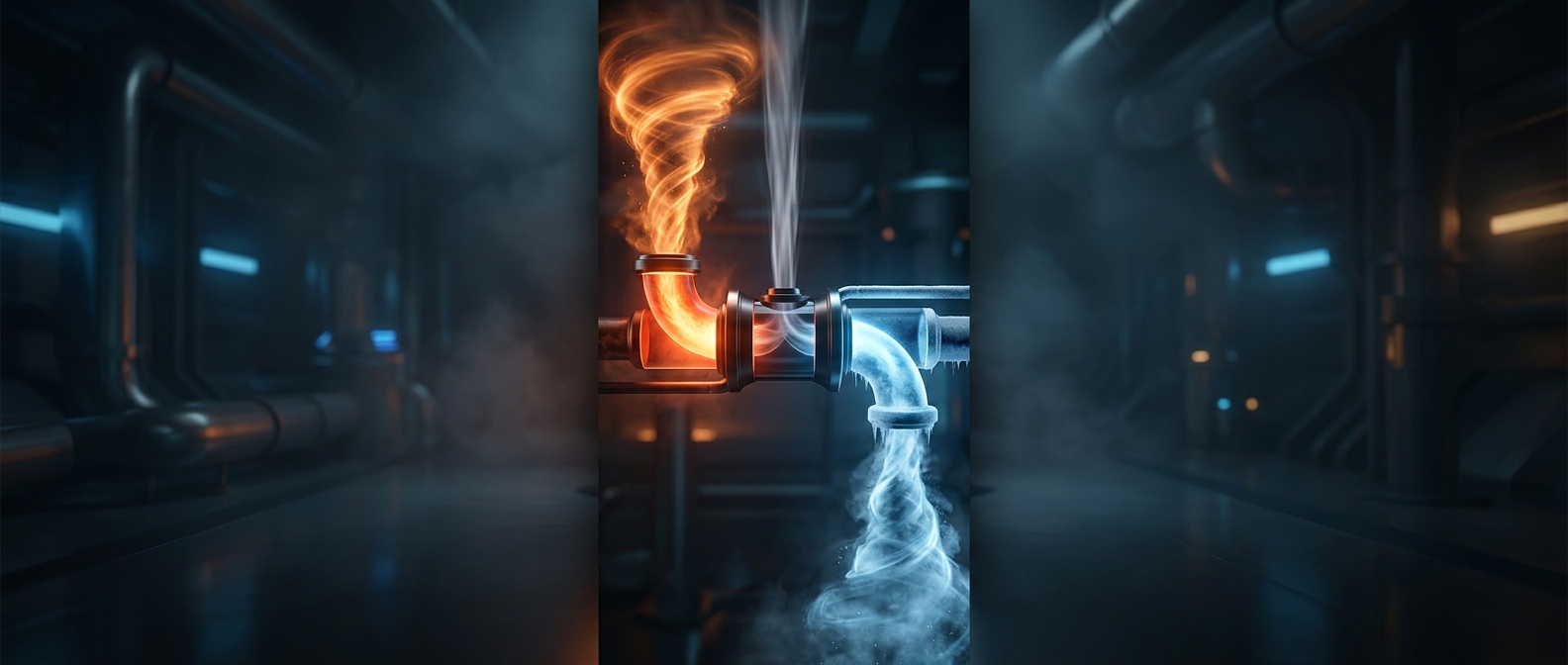
A valve at the far end lets some of the swirling air escape as the hot stream. The rest cannot leave that way, so it turns back through the center of the tube and exits near the inlet as the cold stream. During this circulation, energy is redistributed within the moving air: the outer flow emerges warmer, while the returning core emerges cooler.
It is tempting to explain the effect as centrifugal force simply pushing heat outward, but that is incomplete. The detailed flow is complex, and the temperature split results from the interaction of the rotating gas, pressure changes, and the flow’s reversal inside the tube—not from a spinning part extracting heat mechanically.
Simple hardware, demanding energy
Because the tube has no turbine, motor, or other moving parts, it can be compact and require little maintenance. But it does not create cooling from nothing: the compressor that supplies its air consumes energy, and the tube is generally less energy-efficient than conventional refrigeration. Its appeal is therefore practical rather than economical at large scale—when a small, localized stream of cold air is useful and a compressor is already available, the tube can provide it with remarkably simple hardware.