How a steam push becomes continuous motion
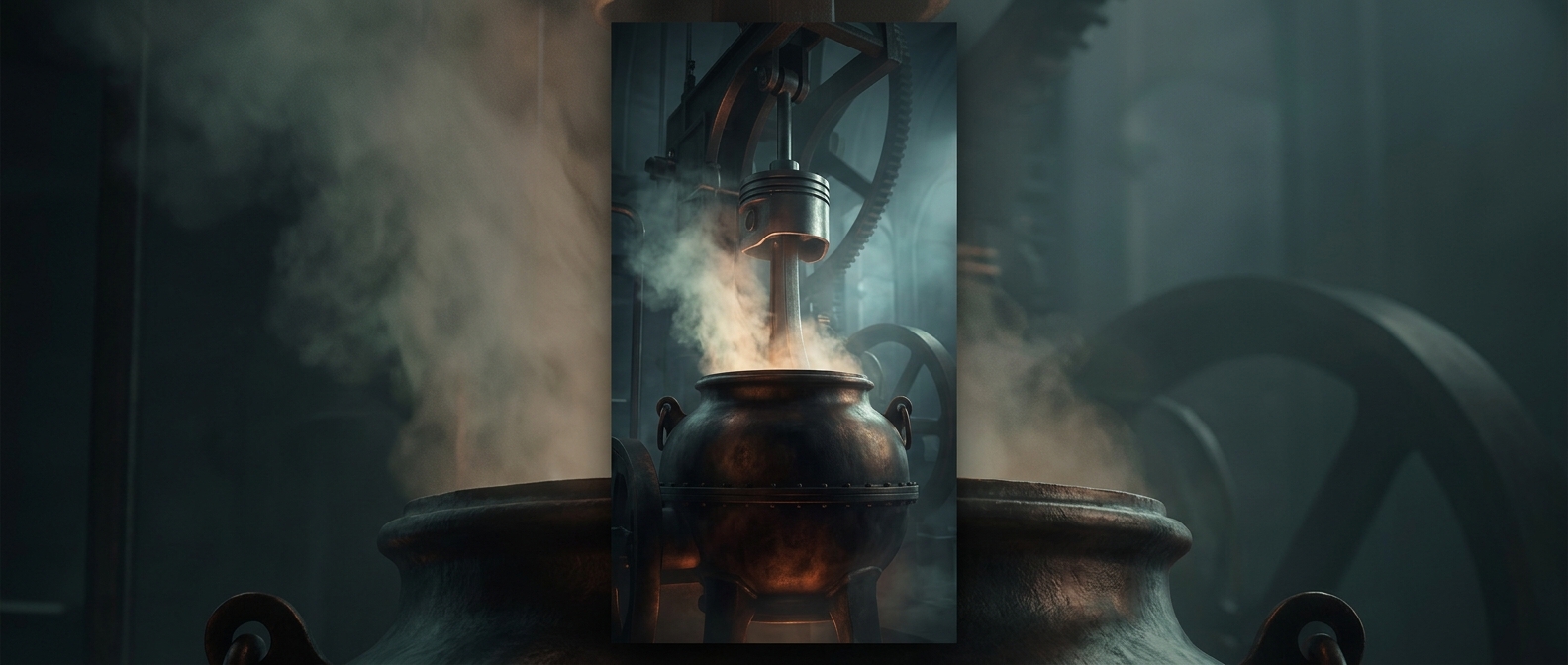
A piston only moves one way when pressure pushes on it. To keep an engine running, a valve system alternately admits steam to opposite sides of the piston and lets used steam escape. That makes the piston travel back and forth inside its cylinder instead of stopping after a single stroke.
A connecting rod carries that motion to a crankshaft, which turns the engine’s back-and-forth movement into rotation. A heavy flywheel helps smooth the rotation: it stores energy as it turns and carries the crank through the points where the piston’s leverage is weakest. The result can drive wheels, pumps, or factory machinery.
The kettle analogy has a crucial limit
A kettle releases steam into open air; an engine directs it into a sealed cylinder and controls when it enters and leaves. That control is what makes pressure useful as a repeated, timed force rather than a one-time burst. In many engines, the exhaust steam is cooled and condensed back into water, helping draw it out of the cylinder and allowing the cycle to continue.
The essential trick is not simply making steam, but guiding its pressure through a sequence of valves, piston strokes, and turning parts. That sequence turns heat into motion a machine can use.