Why a fictional decision can feel like your responsibility
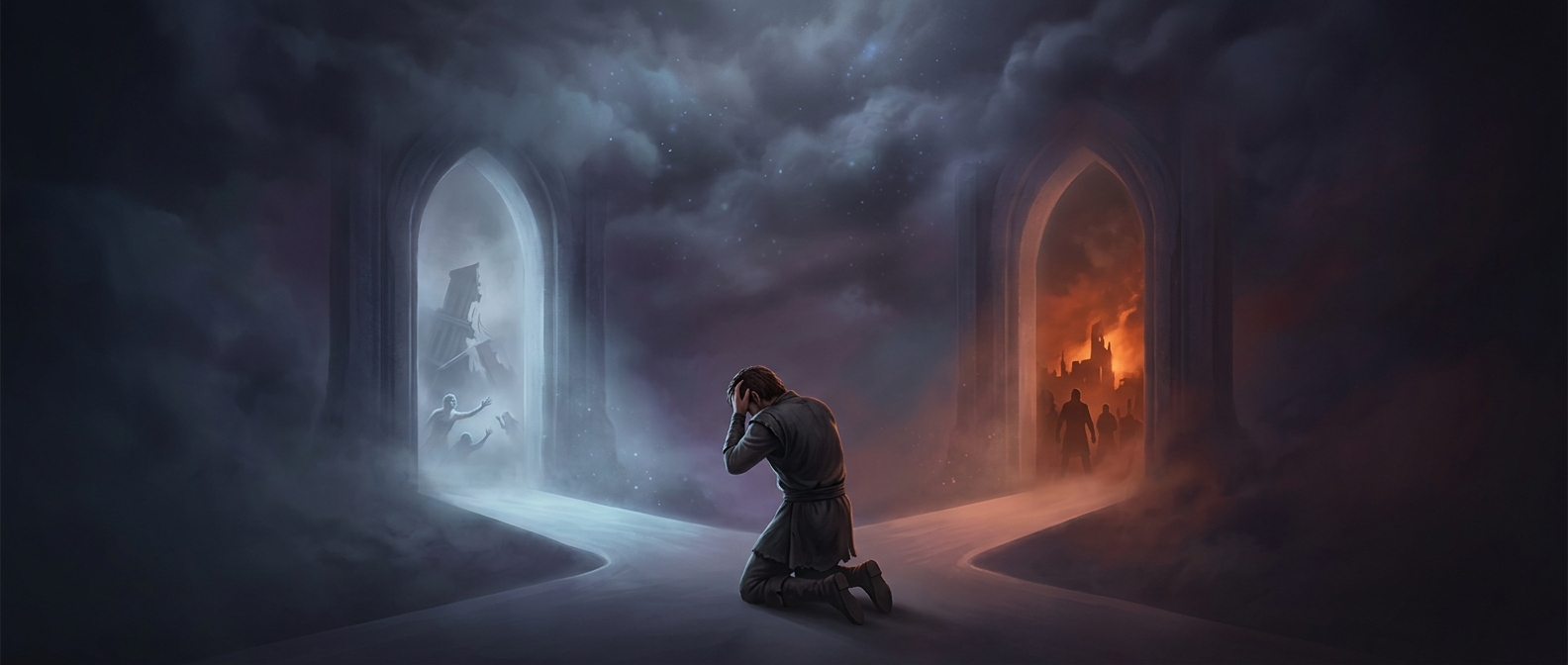
A story game does more than show a character facing a dilemma: it asks the player to act. Pressing a button to choose one outcome creates a small but important shift in perspective. The consequence belongs to the story’s character, but the decision feels like it came from the person holding the controller.
That feeling grows when the game makes the stakes legible. If a choice could cost someone a relationship, a safety, or a future, the player can weigh those possibilities before acting. A pause, a limited time to respond, or a companion’s visible reaction can make the moment feel less like selecting a menu option and more like taking responsibility under pressure.
How games make choices matter
Designers can connect a decision to later scenes: a character remembers what happened, an ally behaves differently, or a path through the story changes. Even when the larger plot eventually converges, smaller differences in dialogue and relationships can signal that the player’s action counted. The effect depends not only on how many outcomes exist, but on whether the game makes the consequences understandable and emotionally specific.
There is a tradeoff. A game cannot account for every interpretation or action a player might imagine, so it must define a limited set of choices. Too little explanation can make a result feel arbitrary; too much can turn a moral dilemma into a calculation with an obvious answer. Leaving some uncertainty preserves the tension—but can also leave players unsure what their choice meant.
Why the decision can linger
After the scene, players may replay it mentally: Was there another way? Did they sacrifice the right person? Because the player participated rather than merely watched, the mind can treat the decision like a small counterfactual—an imagined alternative to what actually happened. That does not mean the fictional stakes are mistaken for real ones. It means the game has made the player’s own judgment part of the experience.
A well-shaped dilemma can therefore remain memorable even after its immediate consequences are over: the player remembers not just what the story did, but what they chose to do within it.