How a tug turns thrust into a sideways shove
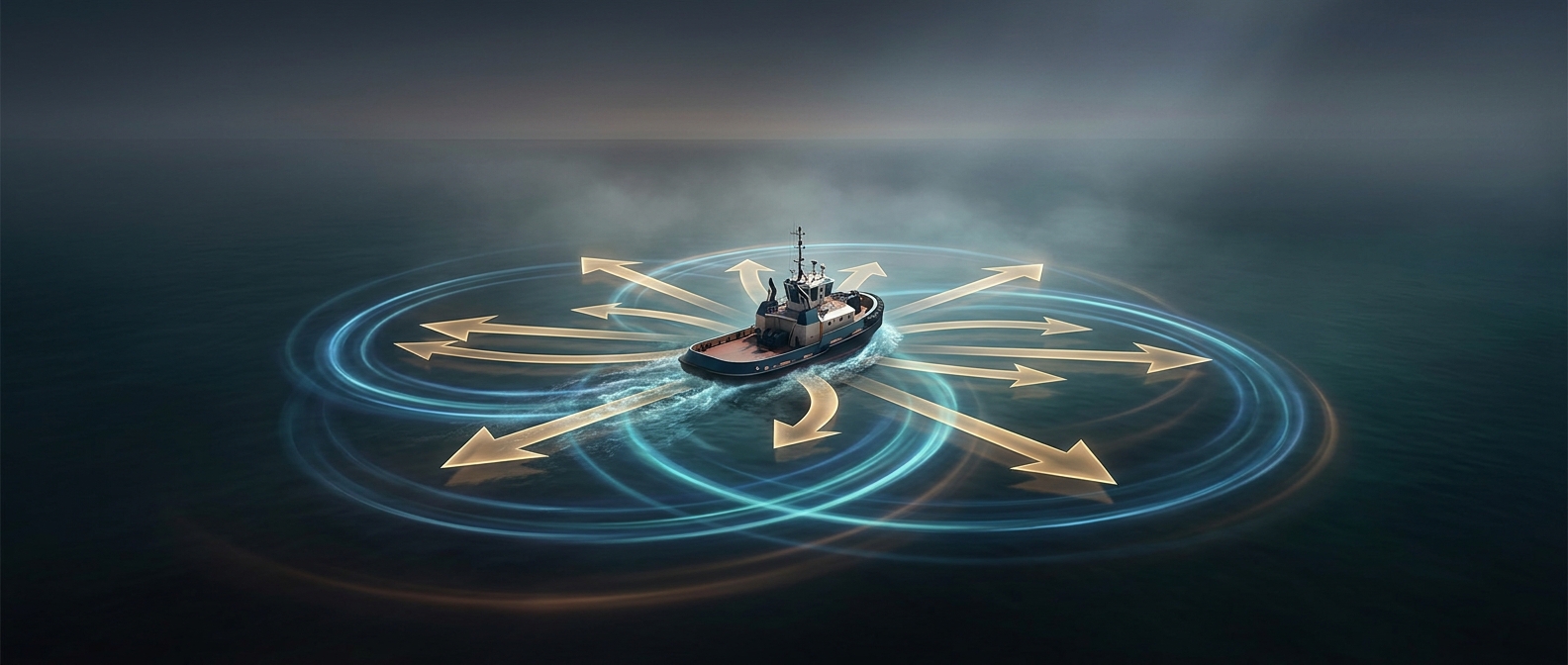
On many modern harbor tugs, each propeller sits in a steerable unit beneath the hull. The unit can swivel, aiming its stream of water in a chosen direction. Because the tug can point its thrust without first turning its own body, it can hold position, slide across a ship’s side, or push at an angle in tight quarters.
The key is that water pushed one way pushes the tug the other way. Aim the propeller’s stream toward the stern, for example, and the reaction force can move the tug sideways. If the tug has two independently steerable units, their thrust can be angled differently: working together they can produce a lateral shove, while opposing or unequal thrust can help pivot the tug.
Why a small tug can move a giant ship
The tug is not trying to accelerate an ocean liner like a car. It applies force gradually, at a useful point on the hull, to help control the ship’s slow movement. A push near the bow or stern can also turn the ship around its center, much as pressure on the end of a long lever turns it more readily than pressure near the middle.
The ship’s mass and momentum still matter, so the tug must work with the pilot and the ship’s engines, rudder, and lines. Its precise, adjustable thrust lets it make corrections that would be awkward for the much larger vessel to make under its own power. That is why a tug can appear to dance alongside a liner: it is steering its force, not merely steering its hull.