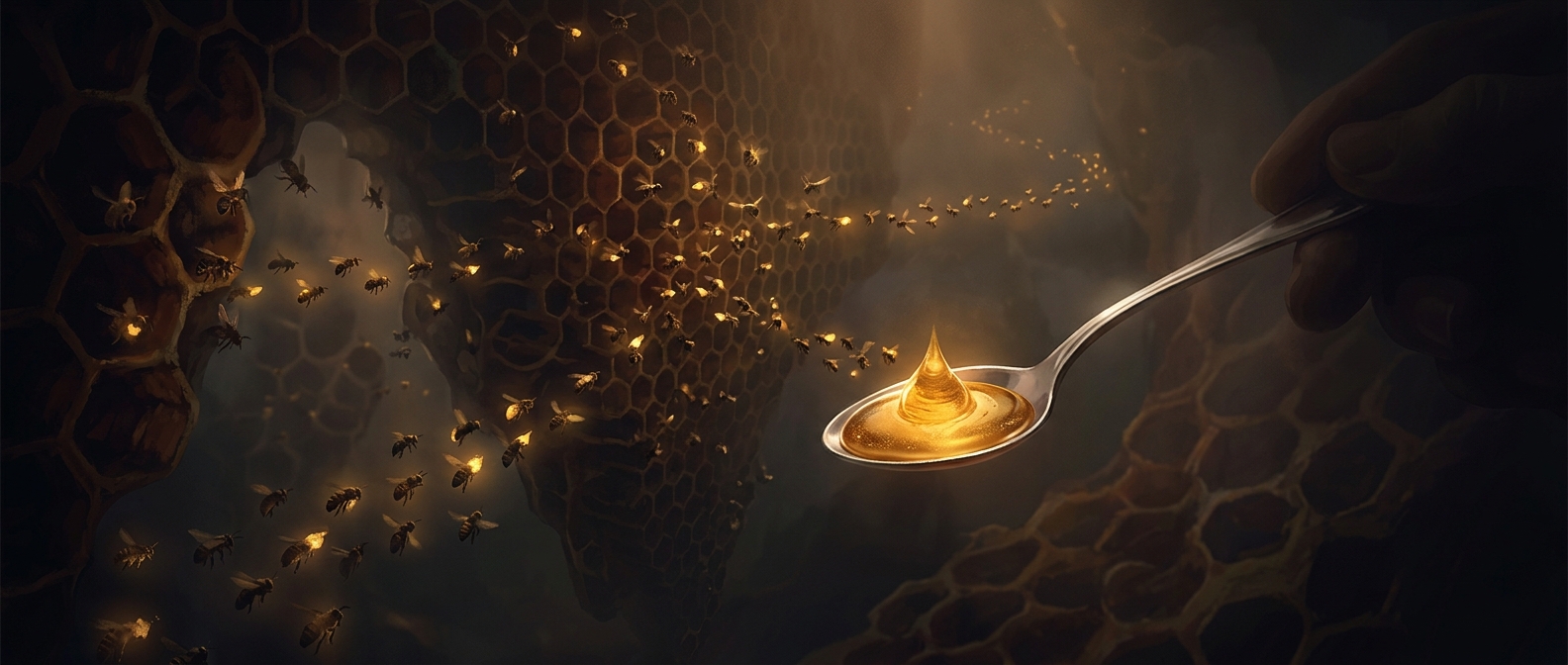
From flower to hive, one drop at a time
A worker bee does not collect finished honey. She gathers nectar, a watery plant fluid, and carries it back to the colony. There, other workers receive and handle it, passing it among themselves. Enzymes—molecules that speed up chemical reactions—begin changing the nectar’s sugars, including by splitting sucrose into simpler sugars.
The work is spread across many small trips and many bees. A single forager brings back only a little nectar at a time, so even a modest amount of honey represents repeated journeys from flowers to the hive.
The hive acts like a food-drying room
Fresh nectar contains too much water to keep well. Bees spread it through the honeycomb and fan their wings, moving air across the open cells. As water evaporates, the sugars become more concentrated. That concentration makes honey less hospitable to the microbes that would spoil a wetter food.
When the mixture is sufficiently concentrated, bees cap the cell with wax. The capped stores give the colony a reserve it can draw on when flowers are unavailable. The transformation is therefore both chemical and physical: enzymes alter the sugars, while airflow removes water.
A lifetime measured in tiny contributions
The teaspoon-sized result is not produced in one dramatic effort. It accumulates through foraging, handoffs, processing, and drying, with each bee contributing a small part of the chain. The memorable scale comes from that division of labor: a spoonful of honey is the stored outcome of countless brief visits to flowers and coordinated work inside the hive.