How Mendelssohn brought the St. Matthew Passion back to the stage
By the early 19th century, Johann Sebastian Bach was admired by musicians, but much of his music was rarely heard in public. His St. Matthew Passion—a large-scale setting of the biblical story of Jesus’ final days, written for soloists, choirs, and orchestra—had not been performed publicly for decades. Its scale and demands made it an unlikely candidate for revival: it required substantial forces and careful preparation, and audiences were more accustomed to newer musical styles.
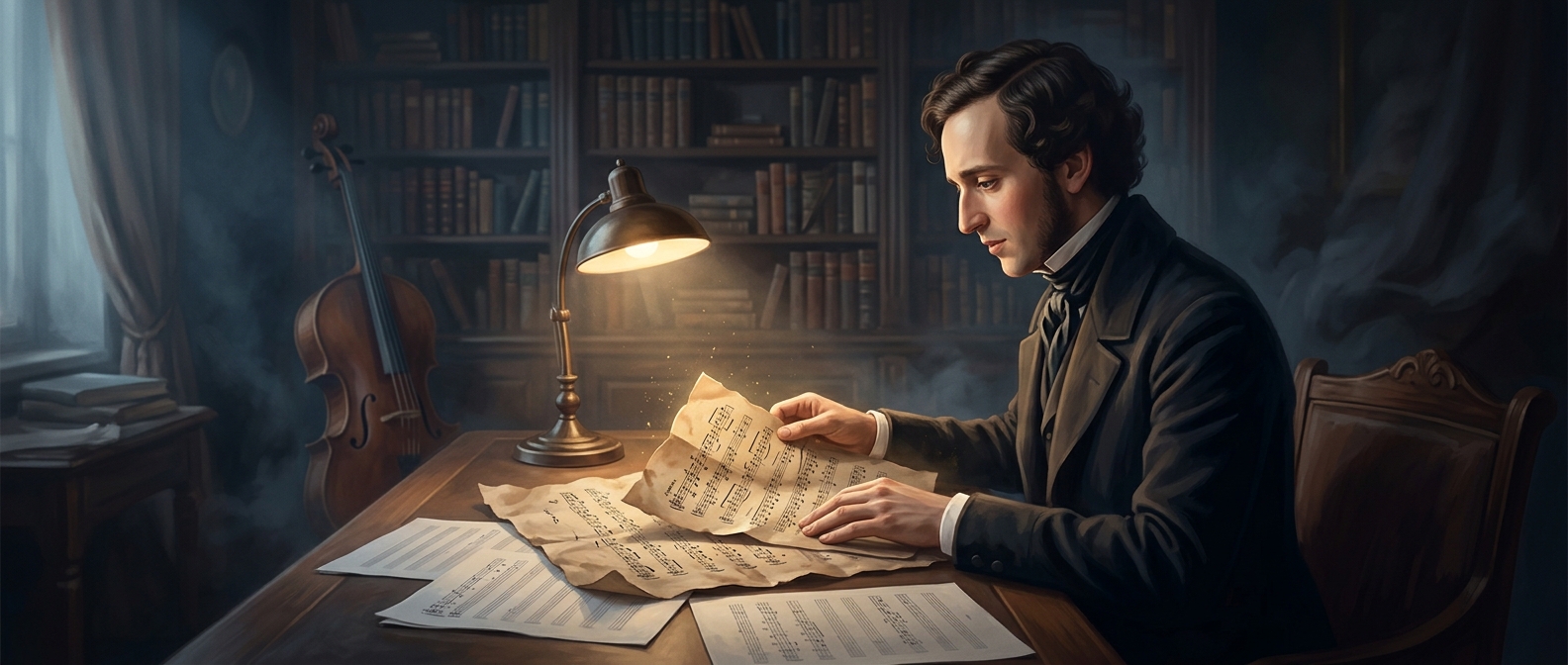
In 1829, Felix Mendelssohn, then a young composer and conductor, led a performance of the work in Berlin. He did not simply reproduce an old score. The performance was prepared for contemporary performers and listeners, making a complex, lengthy work possible to present in a concert setting. Its success showed that Bach’s music could move an audience well beyond the circle of specialists who had continued to study it.
A revival, not a one-man rescue
The story is sometimes condensed into the image of Mendelssohn discovering Bach’s music in a butcher’s shop. That colorful tale is not a reliable account of how the revival happened. Bach’s music had never vanished entirely: musicians preserved and performed parts of it, and Mendelssohn had encountered Bach’s work through his own family’s musical life. The 1829 event mattered because it brought the Passion to a much wider public and gave renewed attention to Bach as a composer worth performing, not merely studying.
The performance helped encourage the broader 19th-century Bach revival, as choirs, musicians, and audiences took fresh interest in his works. A piece once outside regular public life became a landmark of the concert repertoire. Mendelssohn’s achievement was not that he found music no one knew existed, but that he helped turn a neglected masterpiece into a living public event.