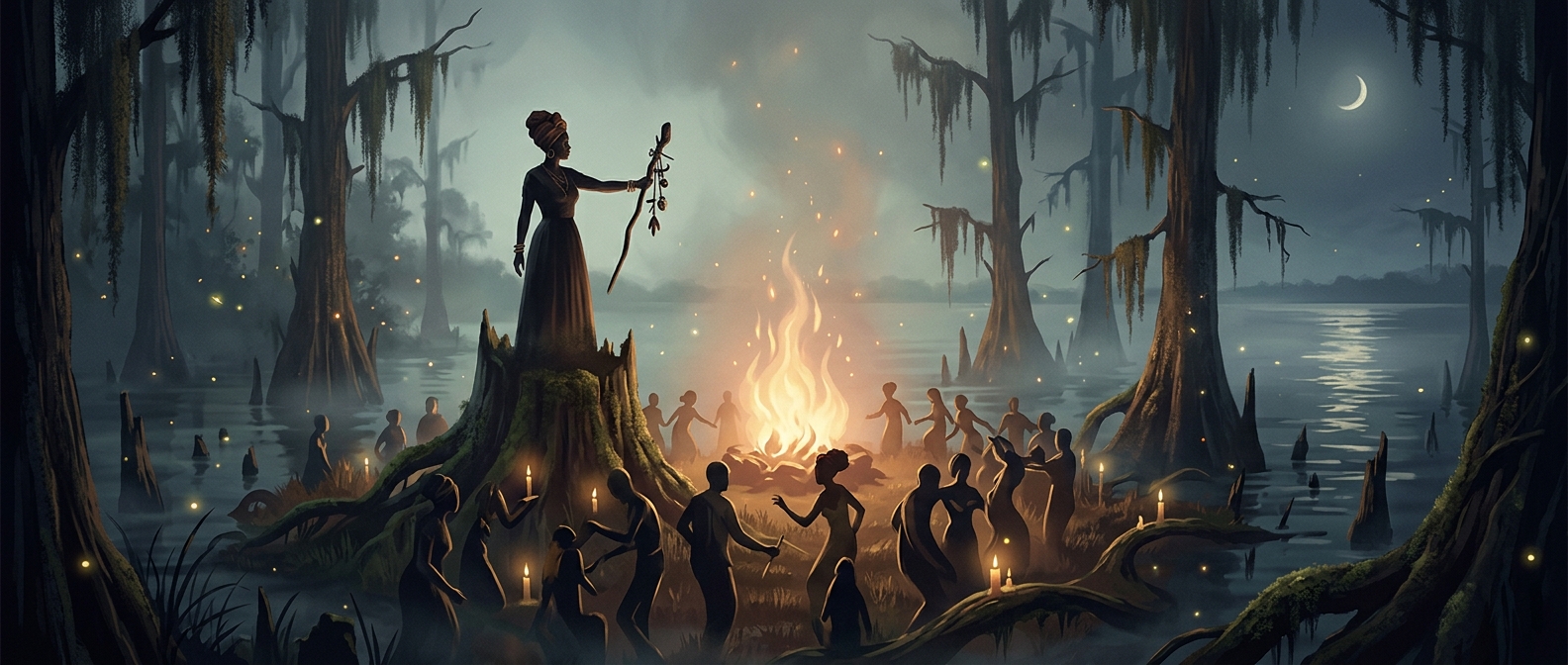
A Voodoo gathering on the lake shore
Marie Laveau’s St. John’s Eve gatherings brought ritual out of private spaces and into a crowded public setting. On the mosquito-heavy shores of Lake Pontchartrain, bonfires, chanting, dancing and snake handling drew large audiences. Laveau charged admission, making the events organized occasions rather than simply informal meetings.
St. John’s Eve falls on June 23, the night before the Christian feast of St. John the Baptist. Its place on the Catholic calendar helps explain why the gathering could carry both religious and communal meaning in Louisiana, where Voodoo developed alongside Catholic traditions. The rituals were not merely spectacle to the people taking part; they belonged to a living spiritual practice.
Why authorities took notice
The crowds were racially integrated, an especially consequential feature in a society structured by racial division. A large gathering that crossed those boundaries, combined with public ritual and paid admission, was difficult for authorities to treat as an ordinary private observance. They were alarmed by the events, though the precise reasons for their concern should not be reduced to a single motive.
Laveau’s influence came partly from her ability to make such gatherings happen at scale: people assembled, shared ritual, and occupied a public landscape together. The striking detail is not just that the ceremonies included fire or snakes, but that they created a space where a diverse crowd could meet on the lake shore under the cover—and scrutiny—of a summer night.