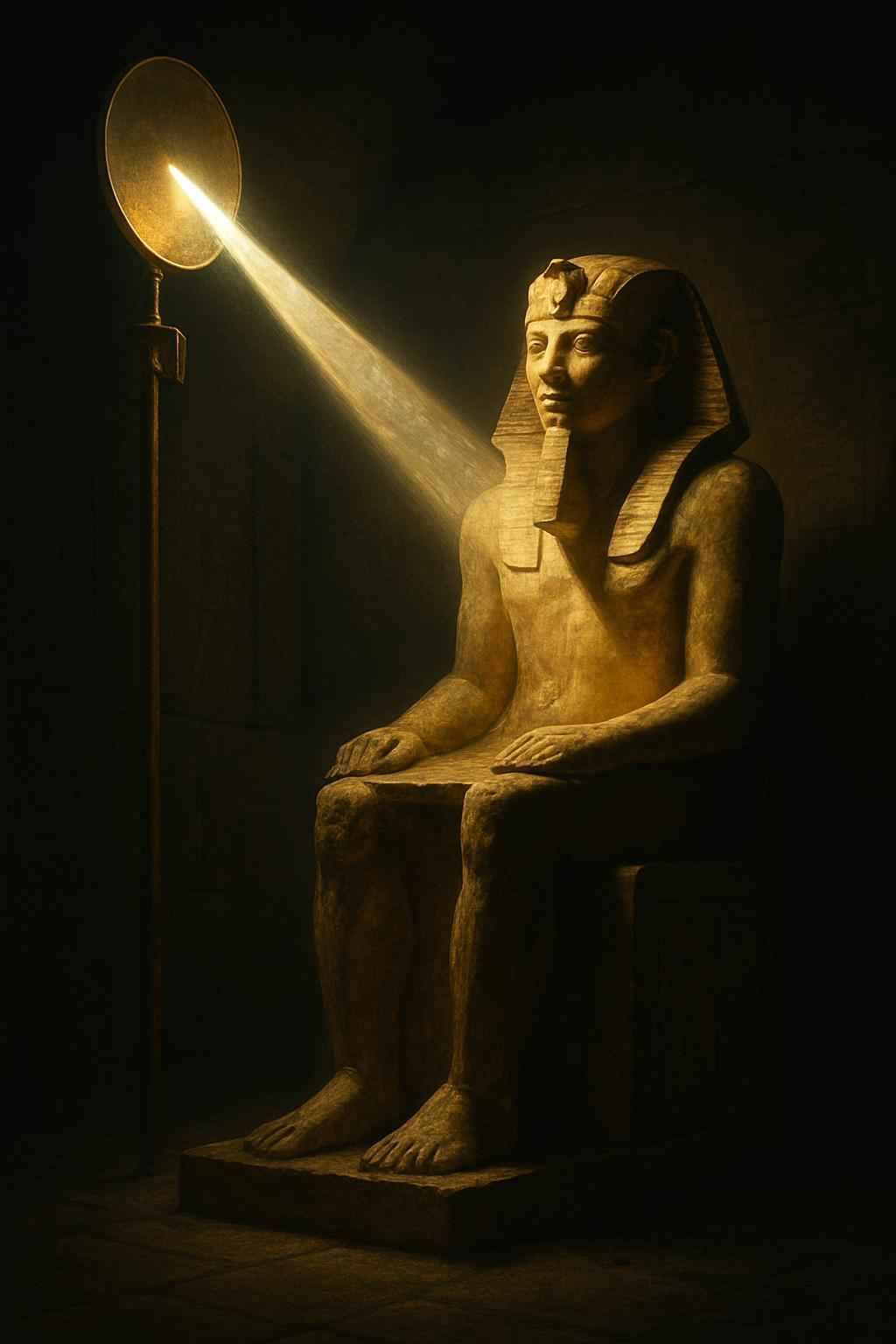
The Hard Part Was Keeping Light Alive
Sunlight does not travel underground by itself. A proposed mirror system would have had to catch a beam at an opening, turn it around corners, and pass it down a corridor while losing some brightness at every reflection. The mirrors would need careful positioning, and the route would work only while the sun was in a useful position. Polished copper can reflect light, but not perfectly; each bounce would dim the beam.
That makes the idea more plausible as a way to brighten a short, carefully aligned passage than as a substitute for lamps throughout a deep temple. A thin sheet of translucent calcite—crystalline stone that lets some light through—might spread a redirected beam, but spreading light also makes it less concentrated.
What the Materials Can—and Cannot—Show
Traces of natron, a naturally occurring mixture of salts used in Egyptian crafts and cleaning, can tell archaeologists about activities at a site. On their own, they do not show that builders used it to create or carry light. Nor does finding copper or polished stone establish that either was part of a hidden lighting system: both materials had many possible uses.
The distinction matters because a working reconstruction is not the same as proof that the ancient builders used that design. The mirror route is an intriguing way to think through the engineering problem, but the surviving materials must be connected to the proposed arrangement before it can be treated as a historical fact.
A Narrower, More Useful Possibility
If redirected daylight was used in a particular space, its value may have been practical as much as spectacular: it could illuminate a dark stretch without bringing an open flame near an enclosed area. But the beam would have been constrained by sun angle, distance, and every turn in the route. The striking possibility is not an underground sun that never failed; it is that a carefully aimed patch of daylight might have reached a place where ordinary sunlight could not.