Why a Pocket Sundial Needed a Place
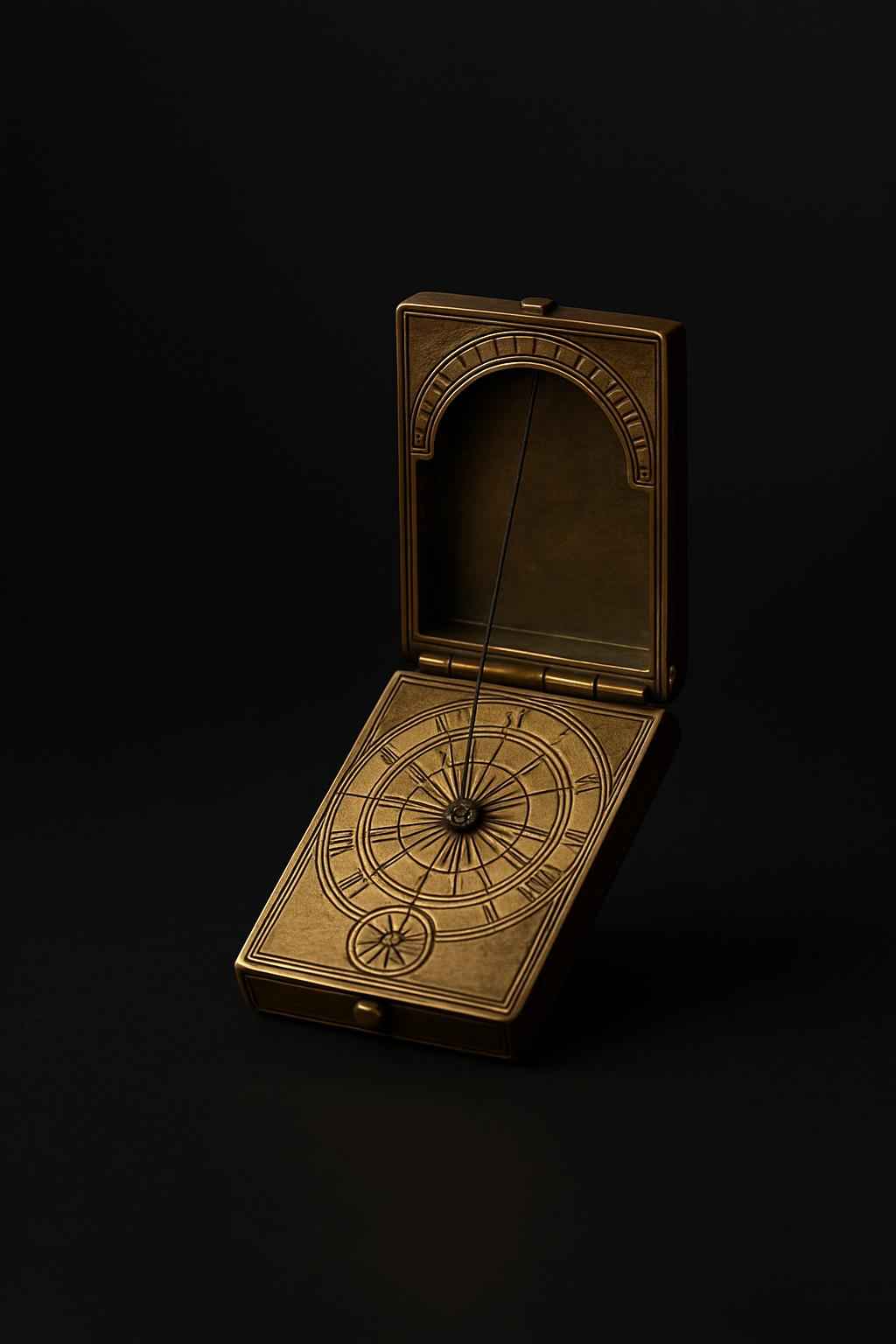
A sundial does not measure time directly. It turns the Sun’s position into a clock reading: as Earth rotates, sunlight moves a shadow across marked hour lines. But the Sun does not trace the same path across the sky everywhere. Its height and seasonal movement change with latitude, so the angle at which a shadow crosses the dial changes too.
That is why a small sundial’s markings had to be calculated for its intended latitude. A dial made for one region could give misleading readings elsewhere, even if its owner carried it carefully and set it in sunlight.
The Traveler Had to Set It Up
Portability did not mean instant convenience. The user had to orient the dial correctly—often with a built-in compass—and position its upright piece, called a gnomon, so it cast the shadow used to read the hour. A compass helped point the instrument, but nearby iron or a poor setup could interfere with that step.
Even a correctly aligned dial showed local solar time, based on the Sun’s apparent motion, rather than a single standardized time shared across distant towns. Longitude also affects when the Sun reaches its highest point. So the reading was useful for the place at hand, not a universal appointment time.
A Timepiece With a Built-In Limit
The portable sundial made the familiar act of checking the time possible far from a tower or fixed dial, but its accuracy depended on both the sky and the traveler. Its portability came with a geographic tradeoff: the instrument could fit in a pocket, yet its markings belonged to a particular part of the world.