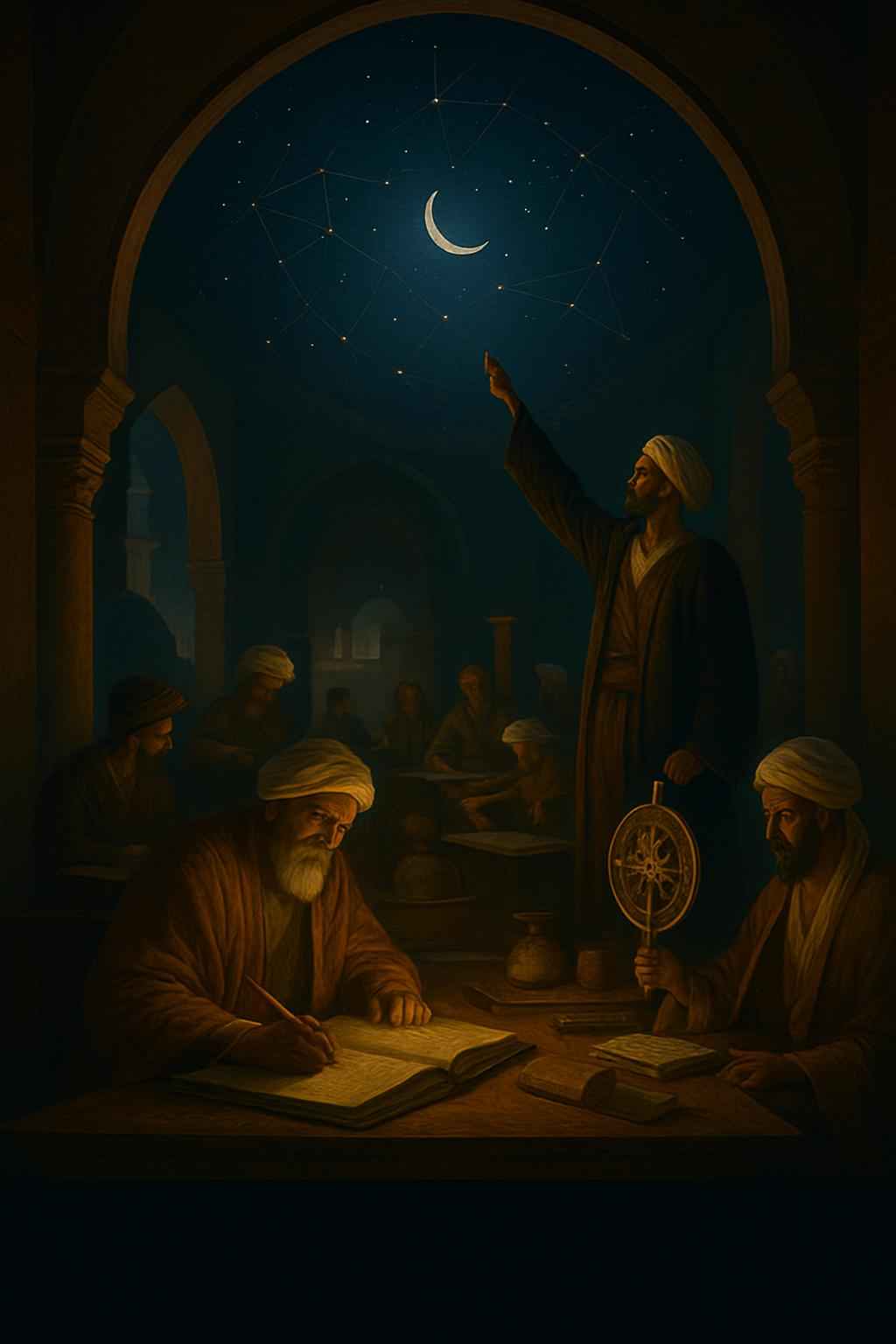
How Baghdad Turned Translation Into Research
The House of Wisdom is often remembered as a library, but its significance lay in more than collecting books. In Abbasid Baghdad, scholars rendered works from Greek, Persian, and Indian traditions into Arabic—a language that allowed readers from different intellectual backgrounds to engage with the same texts. Translation made knowledge easier to compare, teach, and carry forward.
That process was not simply word-for-word copying. A translator had to find Arabic terms for unfamiliar ideas, preserve technical distinctions, and make a text intelligible to new readers. When a source was unclear, scholars could consult other versions or discuss its meaning. The result was a growing body of shared material rather than a set of isolated manuscripts.
From Inherited Texts to New Questions
Once ideas could circulate in a common scholarly language, they could be tested against observation and against other traditions. Astronomers, for example, could study inherited calculations and models, then use them as starting points for further work. Medical writing could likewise be organized, interpreted, and applied by practitioners who had access to a wider range of learning.
The important change was cumulative: a scholar did not have to begin from scratch or work only within one tradition. Translation brought earlier discoveries within reach; teaching, commentary, and investigation made them useful in new settings. Arabic became a working language for scholarship, not merely a container for foreign ideas.
A Network, Not Just a Building
The name House of Wisdom evokes a single grand institution, but the intellectual life of Baghdad depended on people and practices—translators, readers, patrons, and scholars—rather than on a room full of books alone. The city’s achievement was to help create conditions in which knowledge could be preserved and actively developed.
That is why the translations mattered beyond the texts themselves: they gave later scholars something they could question, revise, and build upon.