A molecular rearrangement changes what light gets through
Phenolphthalein’s color shift comes from a change in molecular structure, not from pink pigment simply dissolving into the liquid. In less-basic water, much of the indicator is in a compact, closed-ring form that absorbs little visible light, so the solution looks colorless. As the liquid becomes more basic, the molecule loses hydrogen ions and shifts into a more open form. Its electrons can then spread across a larger part of the molecule, allowing it to absorb visible light; the remaining light gives the solution its pink appearance.
The change happens over a range, commonly described as about pH 8.2 to 10, rather than at one perfectly sharp point. As a result, the first faint pink is a clue that the solution has crossed into the indicator’s color-change range—not a universal sign that every basic liquid has the same pH.
Why chemists use the pink endpoint
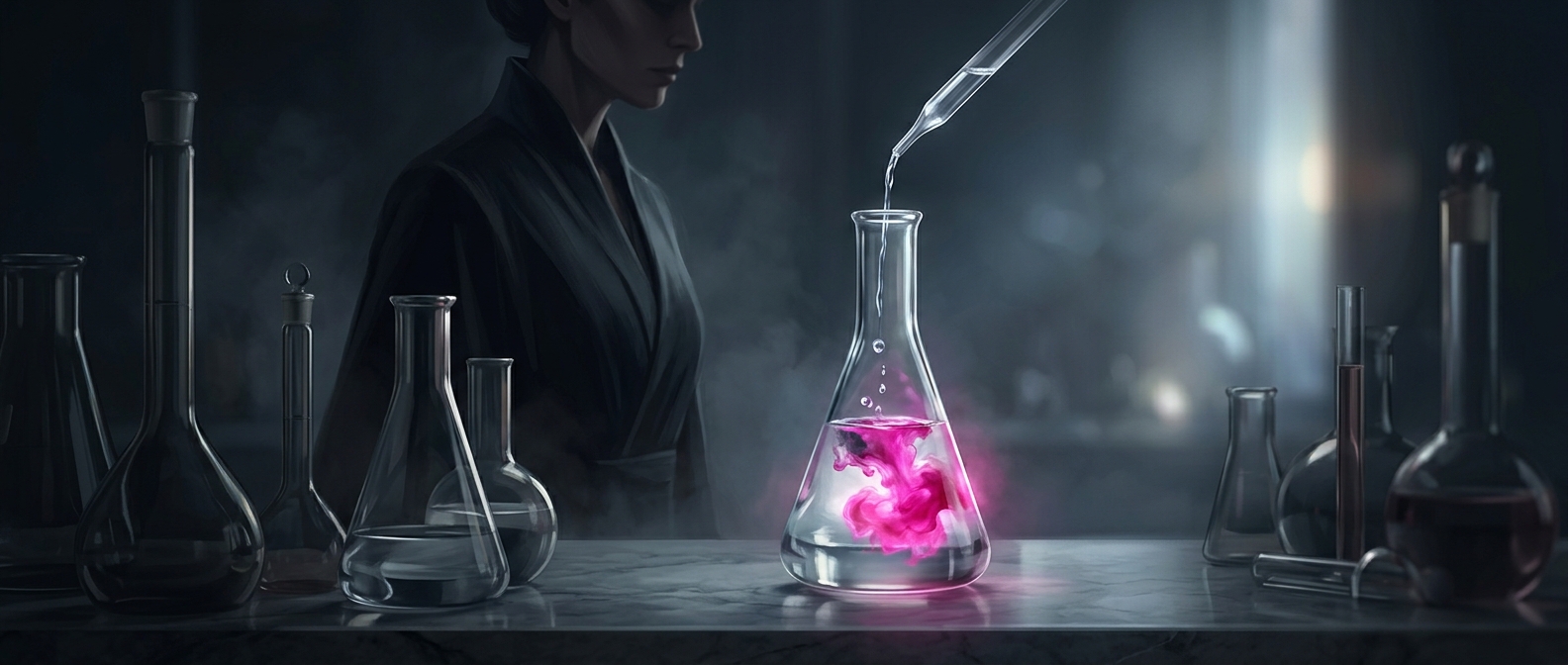
In a titration, a measured solution is added gradually to another solution to find how much is needed for a reaction. If the mixture is colorless at first, phenolphthalein can make the endpoint easy to spot: a small excess of base produces a pale pink that persists when the liquid is mixed. That visible shift helps turn an otherwise invisible chemical balance into a practical stopping signal.
The indicator is useful precisely because its molecular change occurs in a predictable pH neighborhood. It does not measure pH by itself, but it can reveal when a reaction has reached a point near that neighborhood—sometimes with just a single drop making the difference between clear and pink.