Why Some Fats Hold Their Shape
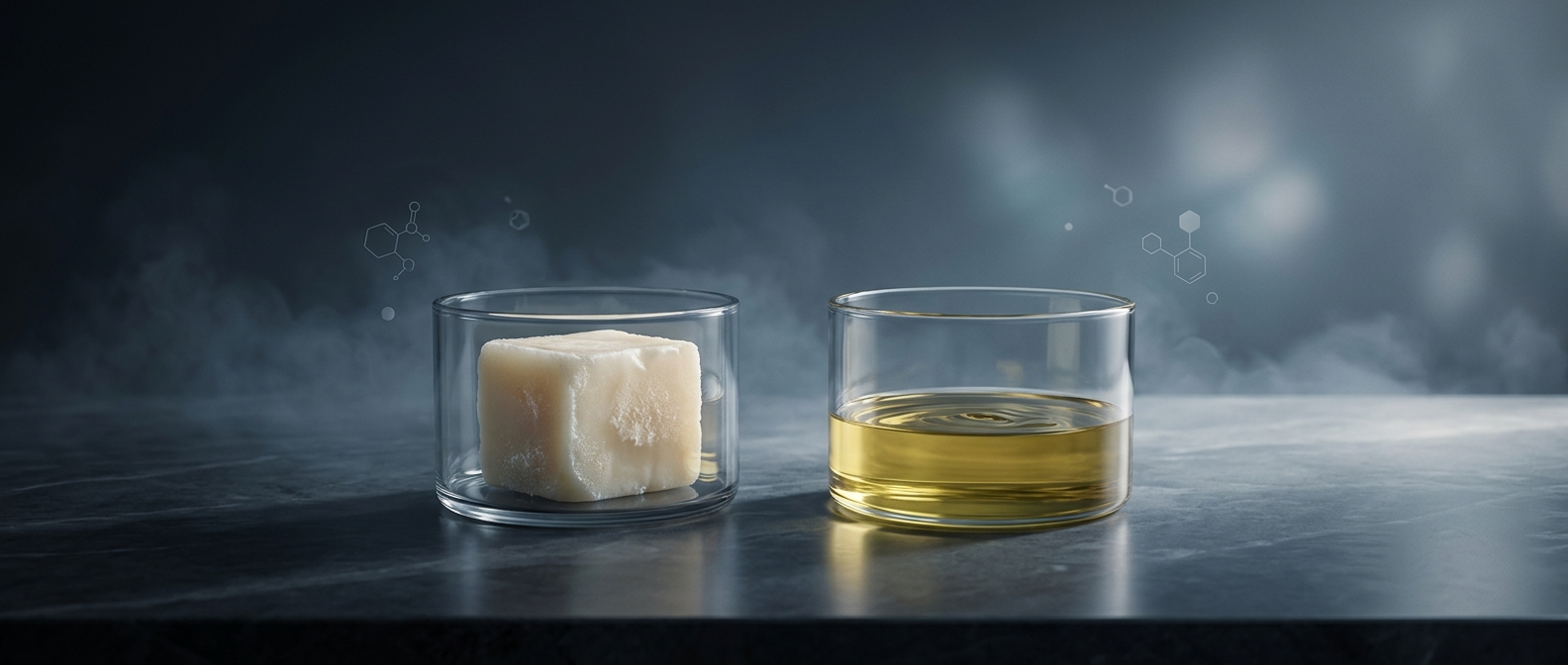
A fat’s texture depends partly on how easily its molecules can move past one another. Saturated fatty acids have no carbon–carbon double bonds, so their chains are relatively straight. They can line up closely, creating stronger attractions between neighboring molecules. More heat is then needed to loosen that arrangement and make the fat flow.
That is why fats rich in saturated fatty acids—such as butter fat—are often firm at room temperature, while many liquid plant oils contain more bent, unsaturated chains that pack less neatly.
The Melting Point Is a Group Effort
Food fats are mixtures, not collections of identical molecules. Their consistency depends on the mix of fatty acids, their chain lengths, and the temperature. A fat can therefore soften over a range rather than switch from solid to liquid at one precise point. “Room temperature” also varies: butter that is firm in a cool kitchen may become spreadable in a warm one.
This is why the saturated-versus-unsaturated distinction predicts texture without determining it absolutely. The overall recipe of fatty acids matters.
Stability Is Not the Same as a Smoke Point
Tightly packed saturated fats are also generally less prone to oxidation than fats rich in polyunsaturated fatty acids. Oxidation is a reaction with oxygen that can damage fats and produce unwanted flavors, especially during heating. But this does not mean every saturated fat is unaffected by cooking: heat, air exposure, and the fat’s composition all matter. Smoke point—the temperature at which a fat visibly smokes—is a separate property.
The useful takeaway is that a solid fat’s firmness reflects how its molecules pack, while its behavior in a hot pan depends on more than whether it is solid at room temperature.