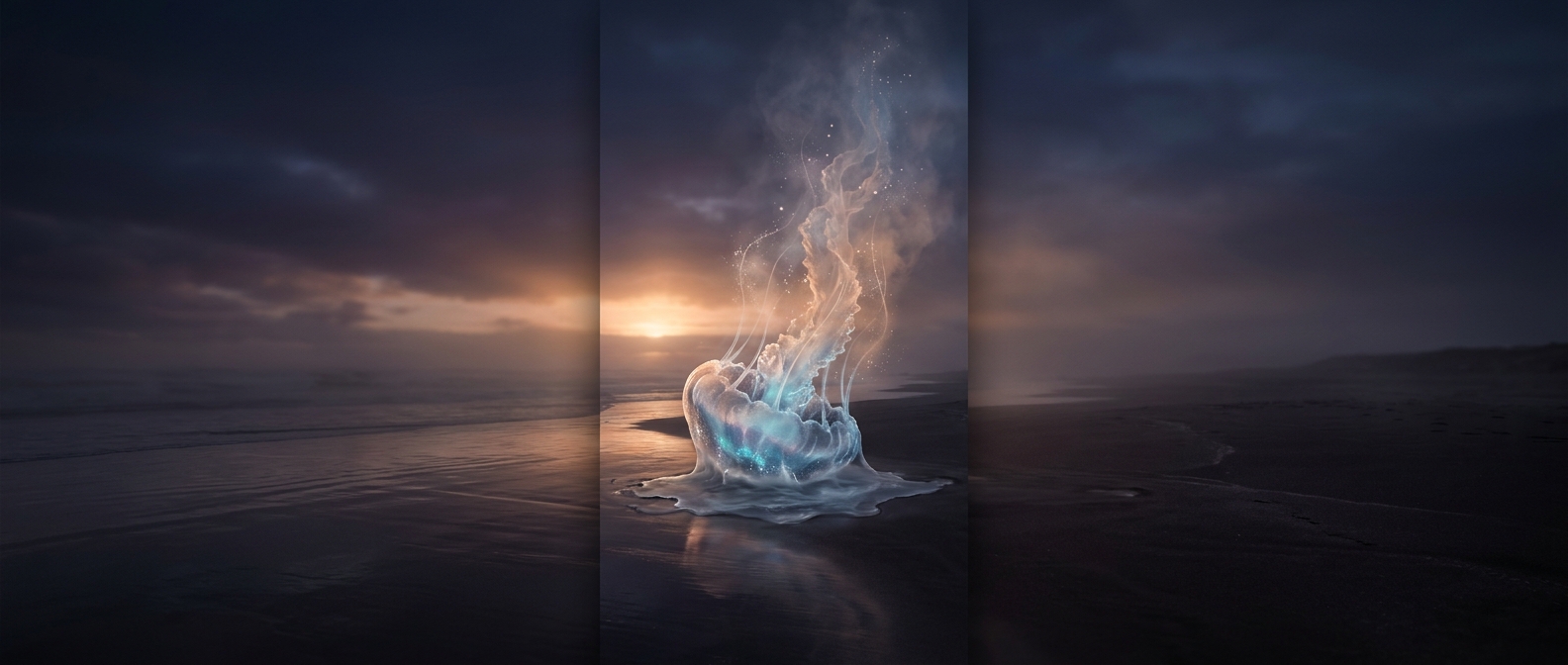
How a stranded jellyfish fades from view
A jellyfish’s body is mostly water, held in a delicate mesh of tissue. Once it washes onto warm, exposed sand, that water evaporates quickly. The bell collapses, the tentacles shrink, and the translucent body can flatten into a thin, nearly clear residue. Against wet or pale sand, that remnant may be difficult to distinguish from the beach around it.
This is not the animal changing color or deliberately hiding. It is a physical change: as the jellyfish loses water, its soft structure loses the shape that made it recognizable. Sun, warmth, wind, and the condition of the stranded animal all affect how quickly the body dries.
Why the sting can outlast the shape
Jellyfish sting with nematocysts—tiny capsules in their stinging cells that discharge a microscopic, barbed thread when triggered. The thread delivers venom through the skin. A jellyfish does not need to be swimming, or even alive, for some of its stinging cells to remain capable of firing.
Drying can eventually disable those cells, but a remnant that still contains moisture may retain active stinging cells. Touching it can provide the physical or chemical trigger they respond to. That is why a nearly invisible strand or flattened patch can still cause a painful sting, even though it no longer looks like a whole animal.
A practical consequence on the beach
The danger is easy to underestimate because appearance is a poor guide to whether a stranded jellyfish can sting. Avoid touching jellyfish or translucent material that may be part of one, and keep children and pets from investigating it. A faded warning sign is still a reason to give the remains space.