The camera move is built from separate viewpoints
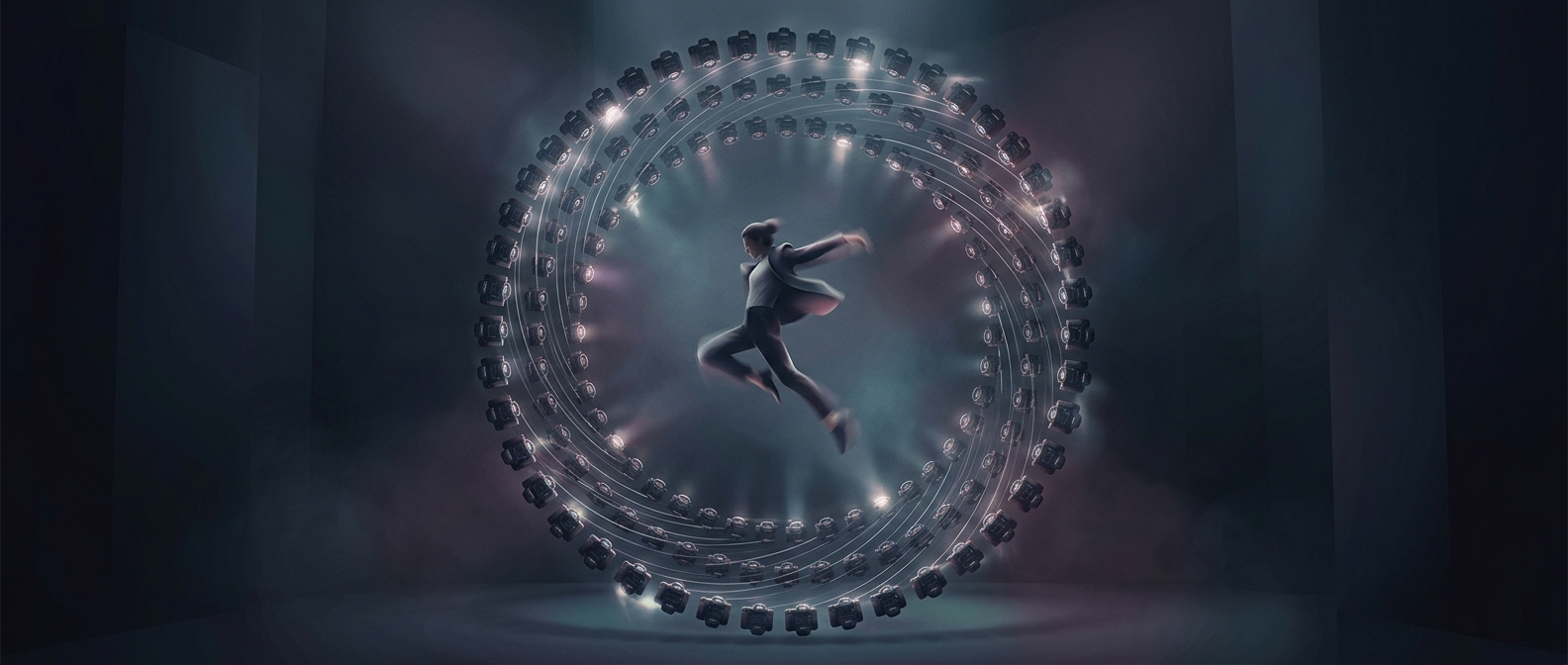
A camera appears to sweep around an actor, but no single camera has to make that trip. Instead, a row or arc of cameras is positioned along the path the shot should seem to follow. Each records the scene from a slightly different place. Played back in order, those views turn a fixed line of cameras into an apparent moving camera.
The effect depends on how the cameras are timed. If they all capture the same instant, the actor’s pose stays nearly unchanged as the viewpoint shifts. If they fire in a rapid sequence, the actor can move a little from one image to the next, adding motion while the viewpoint travels around them.
A brief instant can become a longer shot
In ordinary filmmaking, a moving camera records changing perspectives continuously. In this setup, the images are discrete snapshots: the edit chooses their order and playback speed. Because the action was recorded across multiple cameras rather than by one camera passing through the space, the finished shot can linger on a moment that would normally be over almost immediately.
That also makes the scene a coordination problem. The actor’s movement, the timing of the cameras, and the viewing angle must work together; a gesture that looks clear from one position may be obscured from another. The result feels like time has stopped, but what the audience is really seeing is a carefully arranged sequence of viewpoints—one image at a time.