A lens turned still water into evidence
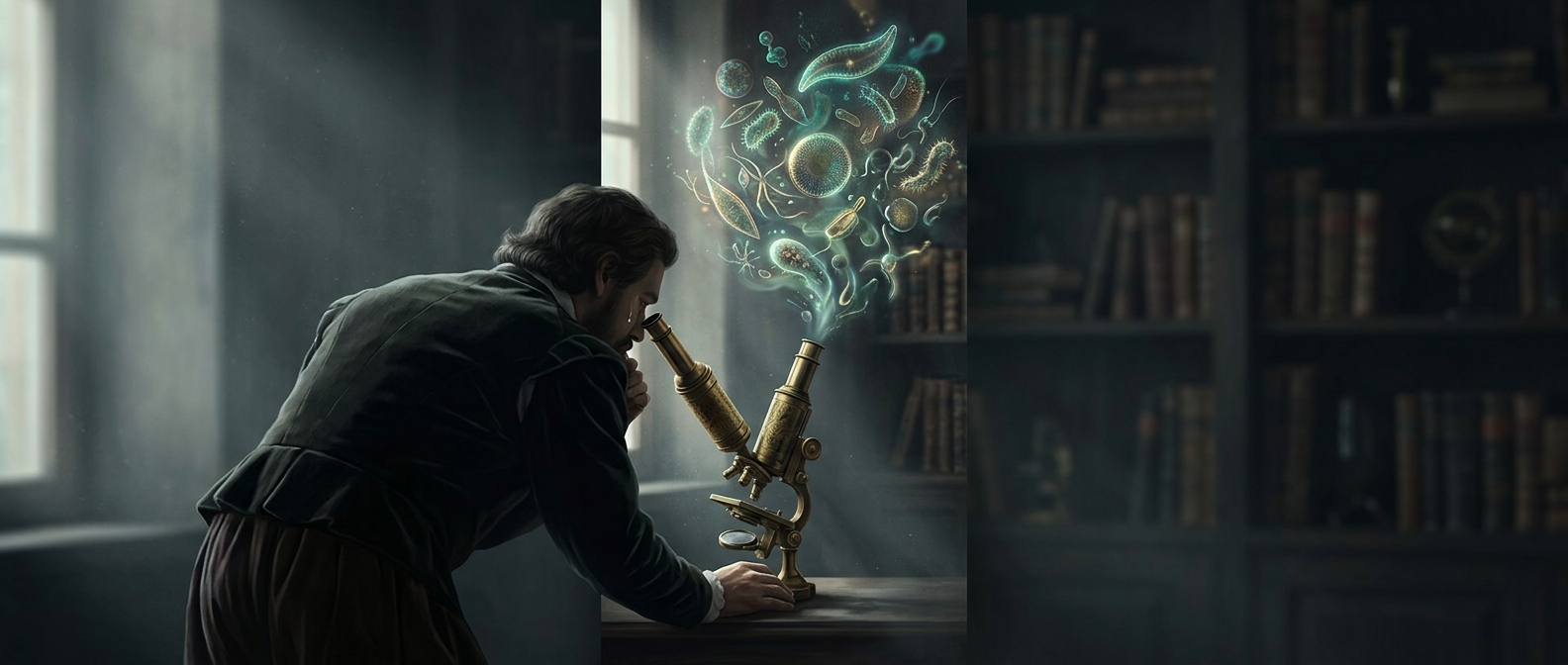
The first surprise was not simply that a lens made small things look bigger. A useful microscope had to resolve them—to keep neighboring details distinct instead of blending them into a blur. In the 17th century, improvements in lens-making made that possible. A drop that seemed empty to the naked eye could now show moving forms with their own shapes and motions.
Antonie van Leeuwenhoek, a Dutch tradesman who painstakingly ground small lenses, built powerful single-lens microscopes and described tiny organisms he called “animalcules.” His reports, sent to London’s Royal Society beginning in the 1670s, gave readers a world they could not inspect without specialized equipment. The observations were so unfamiliar that they had to be checked: members of the society examined samples and sought confirmation before accepting his accounts.
The discovery changed what counted as a living world
Microscopes made life visible at a scale where ordinary experience offered no warning of it. Movement in water was no longer automatically evidence of a larger creature or a passing current; some of it came from organisms too small to see unaided. That distinction opened a new kind of investigation: scientists could compare specimens, describe their forms, and ask what conditions made them appear or multiply.
The instrument did not explain what the organisms were or how they lived. It made those questions possible. A pond’s surface could look motionless while, just beyond the limits of unaided sight, its water was full of activity.