Why a Sundial’s Gnomon Follows Earth’s Axis
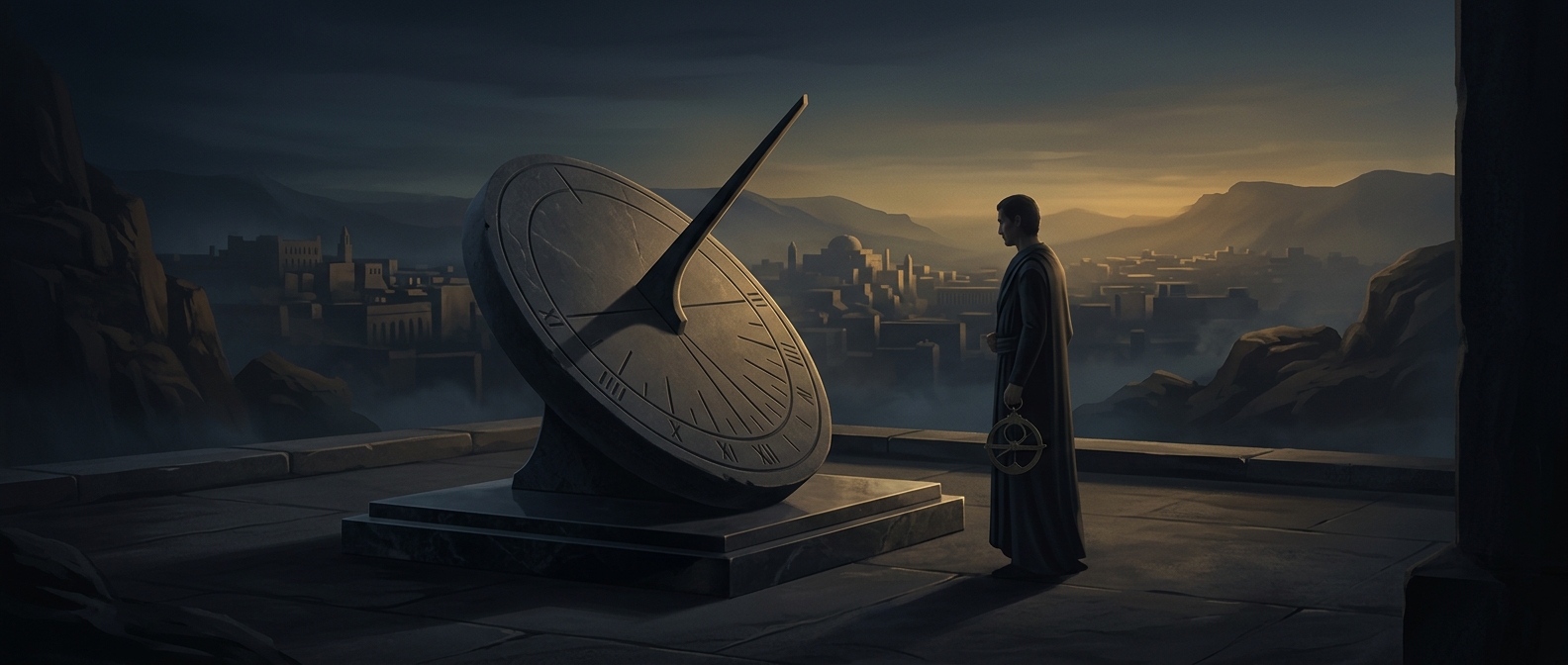
A sundial works because the Sun’s apparent motion is a visible counterpart to Earth’s rotation. As Earth turns, the Sun seems to sweep across the sky, and a fixed pointer—called a gnomon—casts a moving shadow. For that shadow to indicate hours consistently through the year, the gnomon is aimed parallel to Earth’s rotational axis, toward the celestial pole.
That alignment makes the shadow’s daily motion track the rotation of the sky rather than the Sun’s changing height across the seasons. On a typical horizontal sundial, the gnomon’s tilt above the ground matches the observer’s latitude: it leans more steeply at higher latitudes. The hour marks are laid out to suit that same location, because the axis meets the horizon at a different angle as you move north or south.
What the Shadow Measures—and What It Doesn’t
Earth turns about 15 degrees in an hour, so the shadow advances across the dial’s hour lines as the planet rotates. When the Sun crosses the local meridian—the imaginary north–south line through the sky—it is solar noon, and the shadow points to the dial’s noon mark.
A sundial therefore gives local solar time, not necessarily the time shown on a clock. Clock time is standardized across broad regions, while solar noon depends on where the observer is within one. Even at the same location, the Sun’s apparent pace varies slightly over the year because Earth’s orbit is not a perfect circle and its axis is tilted; this creates a modest seasonal difference between sundial time and clock time.
The practical consequence is that a well-aligned sundial can keep the Sun’s changing seasonal path from scrambling its hour readings—but it tells time by the sky’s local geometry, not by the time zone on a wristwatch.