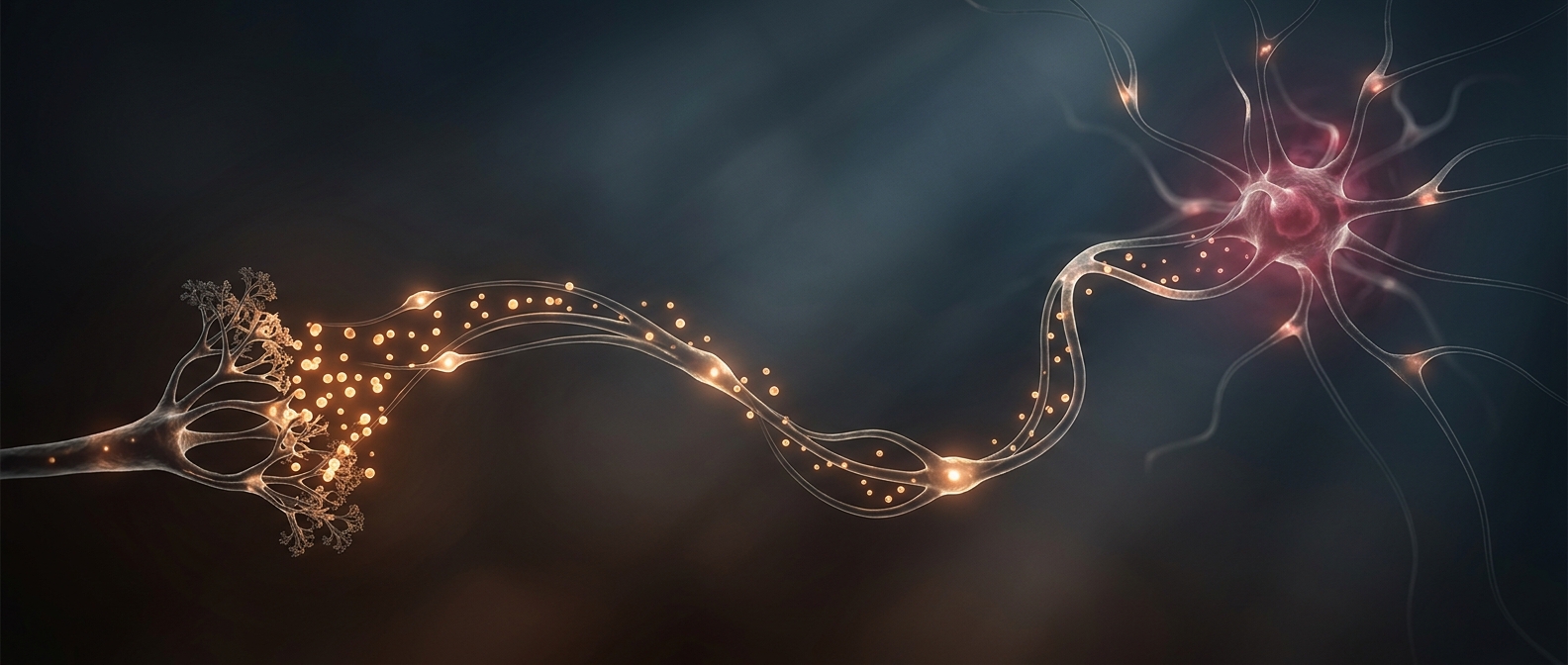
How ganglia route nerve signals
A ganglion is a group of nerve-cell bodies outside the brain and spinal cord. The long fibers extending from those cells connect the group to other nerves, organs, or the central nervous system. That placement lets ganglia organize traffic close to where signals enter or leave the body’s main control centers.
The word “relay” fits some ganglia better than others. In autonomic ganglia, which help regulate functions such as digestion and heart activity, one neuron passes a message to another. The receiving neuron can then carry the signal onward to an organ. This arrangement gives the nervous system a way to distribute commands through branching pathways rather than sending a separate wire from the brain to every target.
Not every ganglion relays in the same way
Sensory ganglia have a different job. They contain the cell bodies of neurons that carry information from the body toward the spinal cord. In many of these neurons, the signal travels along a branching fiber; it does not need to be handed from one neuron to another inside the ganglion. So a ganglion is not always a miniature decision-maker. Its role depends on the kind of nerve cells it contains.
Some responses can also be organized locally in neural circuits without waiting for a conscious decision from the brain. A withdrawal reflex, for example, is coordinated mainly through circuits in the spinal cord—not by a ganglion. The broader principle is that nervous-system work is distributed: different clusters and circuits handle particular steps, while longer pathways carry information between them. That division helps explain how the body can manage routine signals quickly while still keeping the brain informed.