How copper gives malachite its green
Sunlight and ordinary white light contain a mixture of colors. When light reaches malachite, copper ions in the mineral absorb some wavelengths more readily than others. The light that is not absorbed is reflected or scattered back out, and our eyes perceive that returned light as green. The exact shade can vary with the mineral’s composition and structure, from pale green to nearly black.
This is selective absorption, not green pigment painted onto the stone. The same basic principle gives many minerals their characteristic colors: their atoms interact with incoming light in particular ways, removing some colors from what reaches the eye.
Why the stripes record a different process
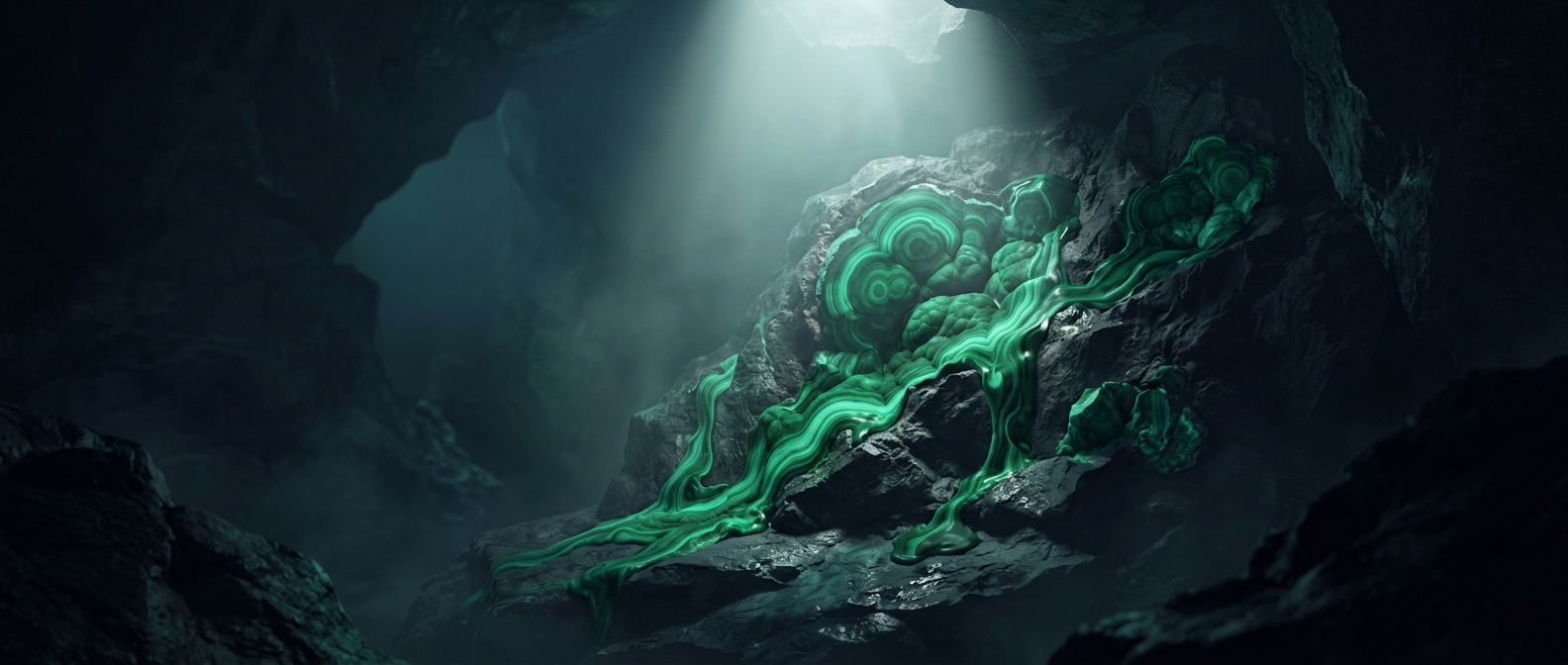
Malachite’s bands are not caused by light. They form as copper-rich mineral material accumulates in successive layers, often coating surfaces or filling spaces in rock. Changes in the conditions as those layers grow—such as the supply of mineral-bearing water—can produce bands with different colors or textures.
Cutting and polishing a piece exposes those layers as stripes, rings, or sweeping patterns. A polished surface therefore reveals two stories at once: copper’s interaction with light creates the vivid green, while the layered growth preserves a visible record of how the mineral formed. Each pattern is a cross-section through that slow accumulation.