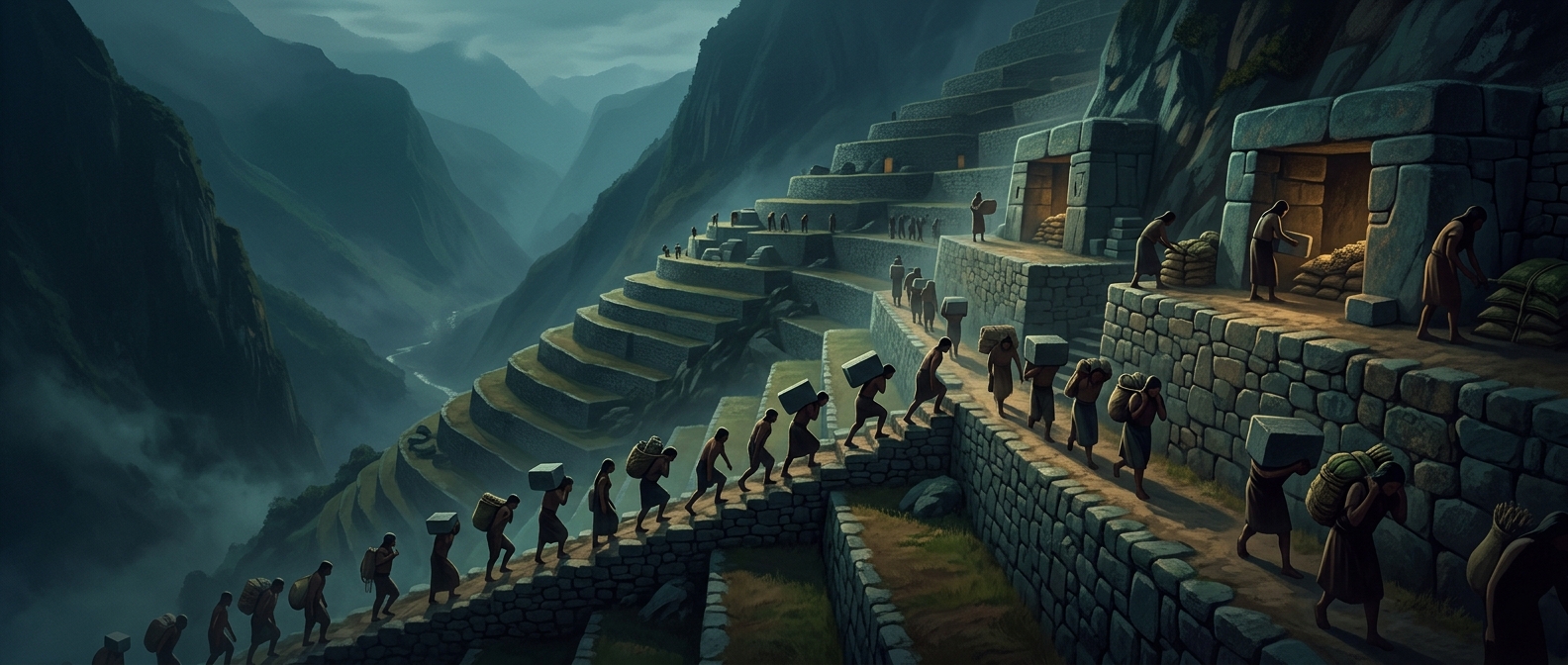
How the Inca Collected Tax in Work
The Inca state did not rely on a money tax system like modern governments. Instead, communities owed mit’a, a rotating labor obligation: people spent a portion of their time doing work assigned by the state. In effect, the tax was paid in labor rather than coins or crops alone.
Local administrators organized workers and directed them to projects the empire needed. The obligation could support farming on state lands, transport, or construction. A road cut into a steep mountainside or a suspension bridge made from grass rope required many hands—and, afterward, repeated labor to keep it usable.
What the State Gained—and What Communities Supplied
This arrangement turned local labor into infrastructure across a vast, difficult landscape. Roads helped officials and messengers travel, while bridges connected routes across deep ravines. The same system could move workers to distant tasks, so the tax was not simply a contribution of effort at home: it could mean leaving one’s community for a work assignment.
The burden was organized through communities rather than collected as an identical individual bill. That made the mit’a a way for the state to mobilize labor at scale, but it also meant households and local leaders had to manage who went and when. The empire’s roads and bridges were built not by a hired workforce paid in wages, but through recurring obligations that converted community time into public works.