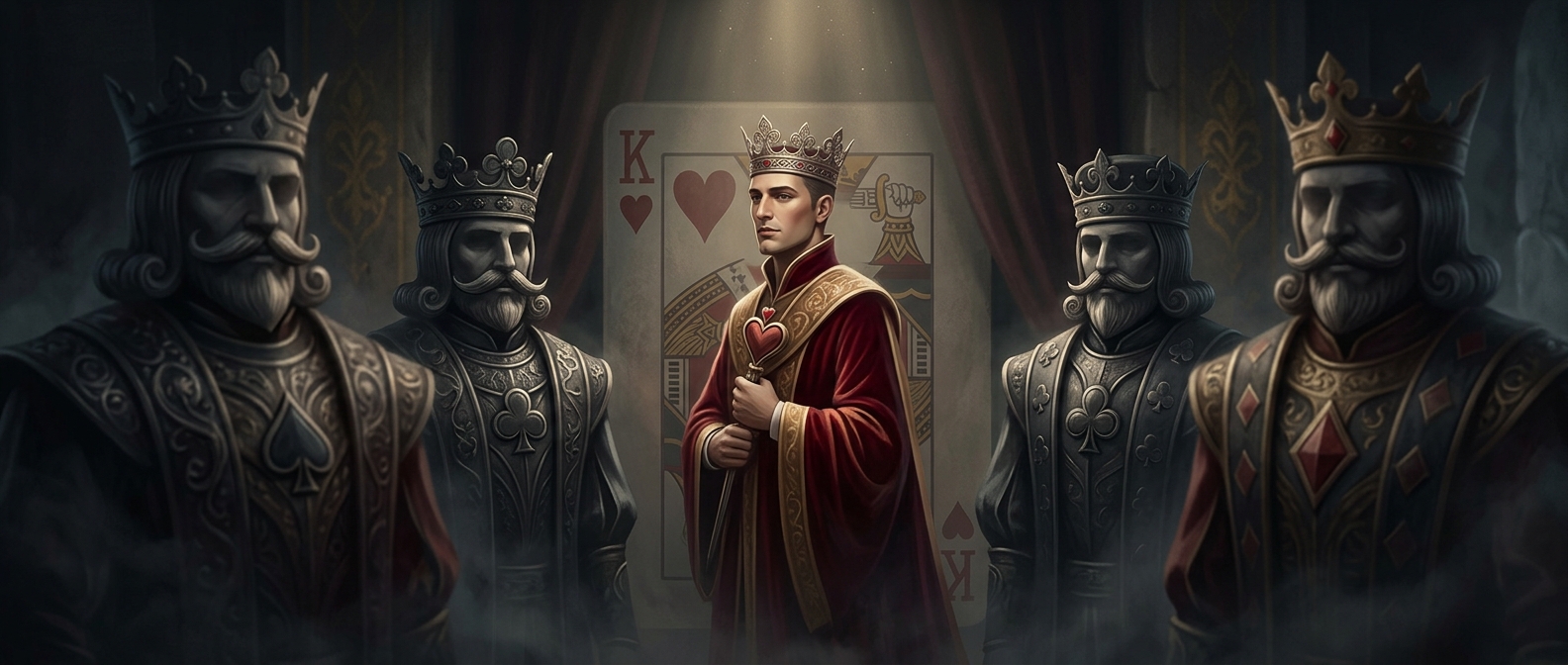
From acorns and leaves to clubs and spades
The familiar French suits did not begin as the simple red-and-black signs printed on modern cards. In a German suit system, two of the emblems were acorns and leaves. French cardmakers reshaped those motifs into a clover-like club and a pointed leaf called a pique—the source of the English word “spade.”
The transformation was visual as well as linguistic. A detailed acorn or leaf could become a compact, repeatable mark: the club’s three rounded lobes suggest a clover, while the spade’s sharp point preserves the leaf’s outline. The names in French reflect that redesign: trèfle means clover, and pique means pike or point.
Why the simpler symbols caught on
French card patterns favored bold shapes that could be reproduced clearly across a deck. Compared with more elaborate suit emblems, compact marks were easier to recognize at a glance and to print repeatedly. That made the French system practical for making large numbers of cards, and its suit symbols spread widely.
The English names preserve a trace of the handoff: “clubs” and “spades” translate the French suit names rather than the German acorn and leaf. So the black symbols in a standard deck are not literal pictures of their older counterparts. They are the result of a redesign that made those motifs simpler—and gave them new names.