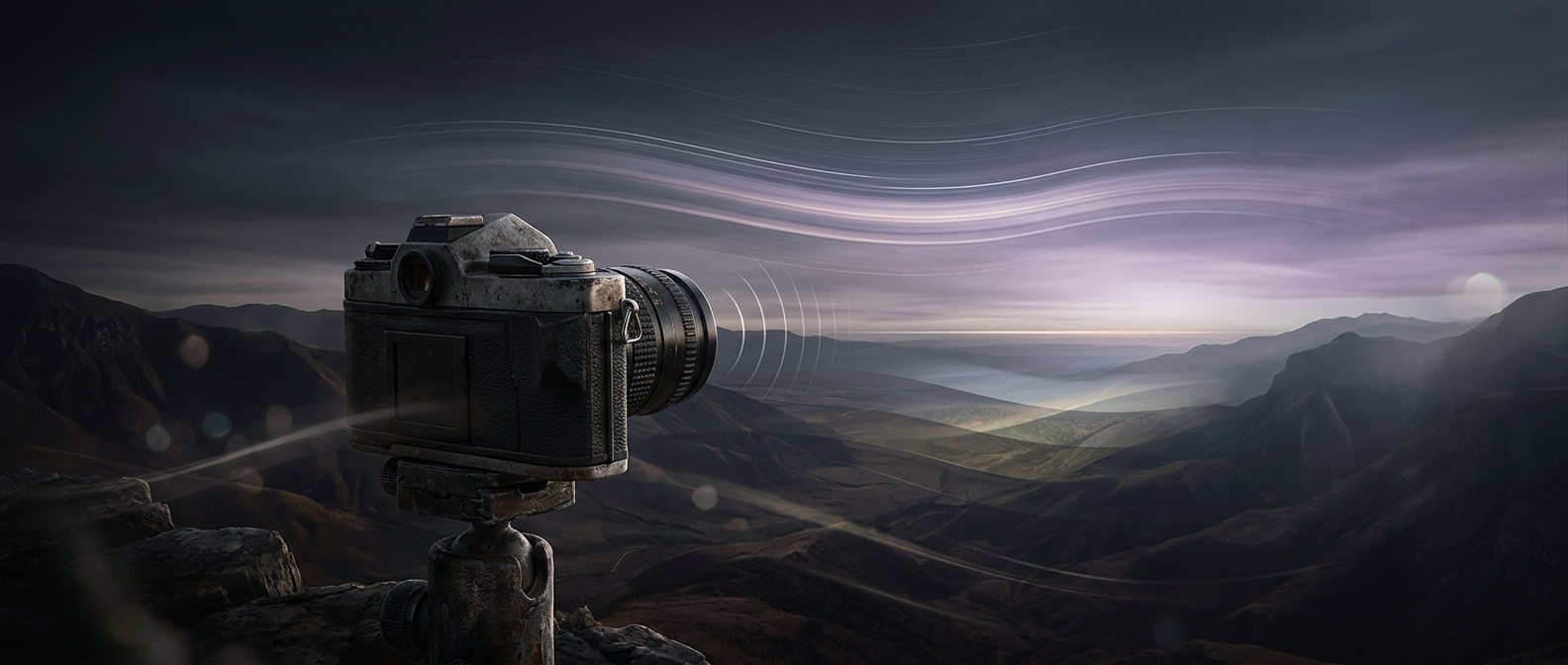
How a Can Became a Camera
A hollowed-out aluminum can can act as a pinhole camera: a dark container with a tiny opening that lets in a narrow stream of light. Photographic paper placed inside records the scene through that opening. With no lens to focus the light, the result is soft and indistinct—but the setup can remain exposed for far longer than an ordinary camera would.
Over nearly eight years, sunlight reaching the paper gradually formed this single image. The can did not take a sequence of pictures; it stayed in place and accumulated light on the same sheet.
The Sun Drew the Long Exposure
As Earth turns, the Sun appears to travel across the sky each day. Its height and path also shift through the seasons. During a very long exposure, those movements register as bands or trails rather than one sharp solar disk. Gaps in the trails can reflect periods when clouds blocked the Sun.
The image is blurry partly because a pinhole has no focusing lens, and partly because light gathered over such an extended span blends changing conditions together. The result is less a snapshot than a record of the Sun repeatedly crossing one patch of sky.
Time Replaces the Shutter
A conventional camera controls exposure with a shutter that opens briefly. In this improvised camera, the pinhole stays open, and the photographic material does the slow work of collecting light. That tradeoff exchanges detail for duration: a simple, inexpensive container can preserve a pattern that would be impossible to see in a single moment.
The striking part is that the can’s limitations become the image’s subject. Its lack of focus softens the scene, while its long, uninterrupted exposure makes the Sun’s changing route visible as one layered trace.