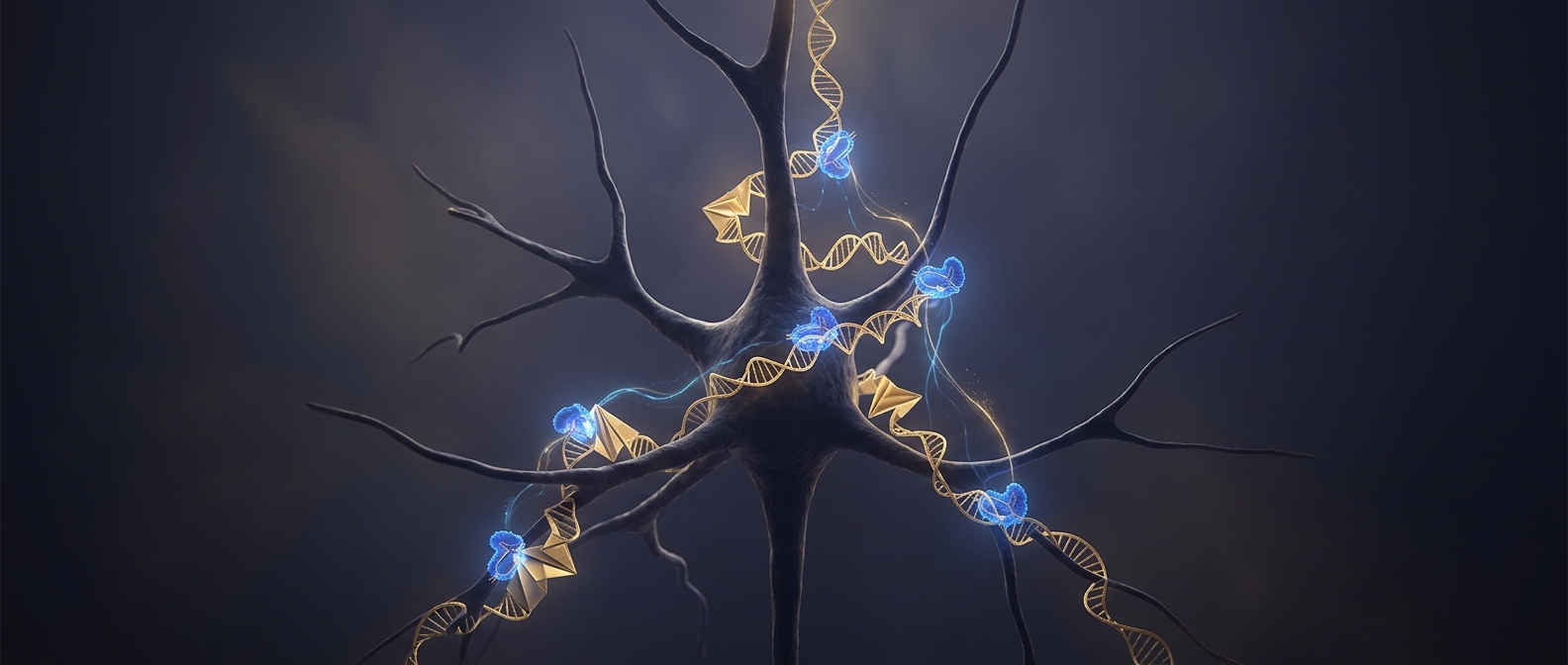
A pore turns DNA into a changing current
A pore-forming bacterial toxin can be repurposed as a sensor because its narrow channel creates a bottleneck for charged particles. In a nanopore sequencing device, the protein sits in an artificial membrane separating salty liquid on either side. An applied voltage drives ions through the pore, producing a small, steady electrical current.
DNA is negatively charged, so the voltage can pull a strand into the channel. As the strand moves through, it partly obstructs the flow of ions. The instrument does not photograph the bases; it records how the current changes as the molecule passes through the pore.
Why reading a strand is harder than spotting one base
The pore’s sensing region is not a point-sized detector. Several DNA bases occupy it at once, and the current depends on that short stretch of sequence. A base therefore cannot always be identified from a single isolated signal: the same letter can produce different readings depending on its neighbors, while different stretches can produce similar readings.
The strand’s movement also has to be slow and controlled enough for the electronics to measure the changing signal. In practice, the device records a succession of current levels as the DNA advances, rather than a clean one-base-at-a-time click track.
Turning the trace back into letters
Software compares the measured pattern with the signal patterns expected from different DNA sequences. Because overlapping bases shape each reading, the task resembles recognizing a sequence of partially blurred marks, not assigning one simple current value to each letter. The program uses the order and duration of signal changes to infer the most likely sequence.
That design lets a tiny protein channel serve as both a passageway and a detector: the DNA itself alters the electrical flow as it moves. The result is a way to read genetic material by following a current trace, one short stretch of DNA at a time.