How a trace of poison became an end-of-the-world threat
In 1910, astronomers found cyanogen—a poisonous gas—in the material surrounding Halley’s Comet. The discovery was real; the danger was not. Reports that Earth would pass through the comet’s tail turned a chemical finding into a frightening question: could the gas poison the air people breathed?
The missing piece was concentration. A substance can be toxic without being dangerous in every amount or setting. The comet’s tail stretched across space, but its material was extraordinarily thin. As Earth moved through it, the gas would be dispersed through the much denser atmosphere, not poured into it like fumes in a sealed room. Detecting cyanogen with astronomical instruments did not mean there was enough to harm anyone on the ground.
Fear found a market
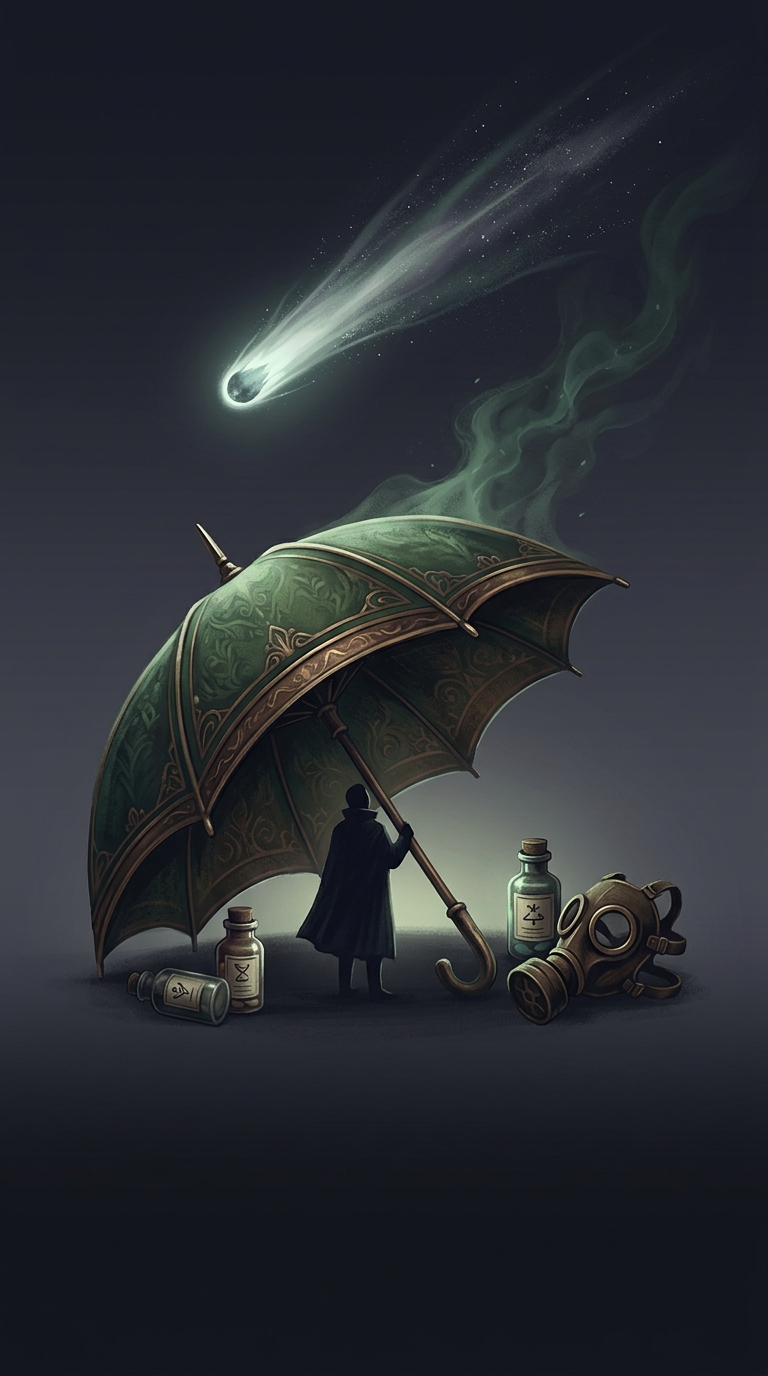
The approaching passage gave newspapers a dramatic story, and sensational predictions helped make the danger feel immediate. Sellers could turn that fear into products: pills advertised as protection, gas masks, and even umbrellas meant to shield people from the comet. Some residents took the more literal precaution of stuffing rags into window gaps.
These measures answered the imagined threat, not the actual physics. A mask or sealed window might seem sensible if poisonous gas were about to seep into homes, but neither addressed the real situation: an exceptionally dilute trace spread through the atmosphere. The panic also showed how easily a technically accurate discovery could be stripped of the scale that gave it meaning.
The crossing put the claim to a test
Earth passed through Halley’s Comet’s tail in May 1910. There was no mass poisoning; ordinary life continued. The episode was not proof that astronomers had fabricated the cyanogen finding. It was a lesson in the difference between detecting a hazard and establishing a harmful dose—a distinction that mattered far more than the alarming name of the gas.