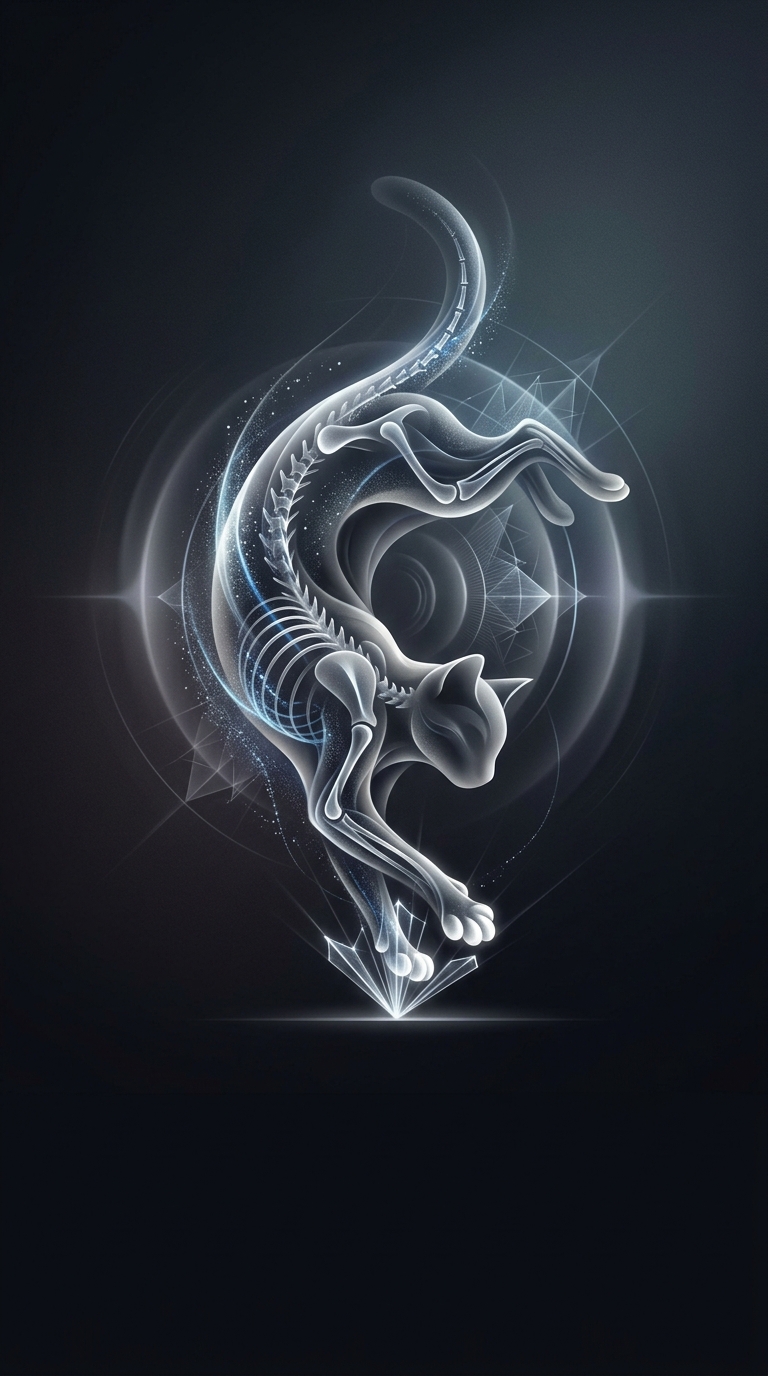
How a Falling Cat Turns in Midair
A cat can change its orientation without pushing off a wall or other object because its body is not one rigid piece. As it falls, it bends at the waist and twists its front and rear halves in different directions. Its flexible spine and joints let the two sections rotate in sequence, so the cat can bring its paws underneath it while its overall angular momentum—the amount of rotational motion it has—stays balanced.
The Righting Reflex, Step by Step
The righting reflex is an automatic response: signals from the cat’s balance system and vision help it detect which way is down. It then folds its legs and changes the shape of its body. One half turns while the other briefly counter-rotates; the cat adjusts its posture and repeats the motion until its head and feet face the right direction.
This is not a single dramatic twist. It is a coordinated series of small changes in body shape. A cat must have enough time to make them, which is why an extremely short fall may end before it completes the turn.
Feet First Is Not the Same as Safe
Once oriented, a cat spreads its limbs and arches its back to help manage the landing. But landing on its feet does not erase the force of impact. Height, surface, and the way the body strikes all matter, and cats can be seriously injured even when they appear to land upright.
The striking trick is that the cat rotates by rearranging its own body, not by finding something to push against. Its flexible frame makes the maneuver possible; it does not make a fall harmless.