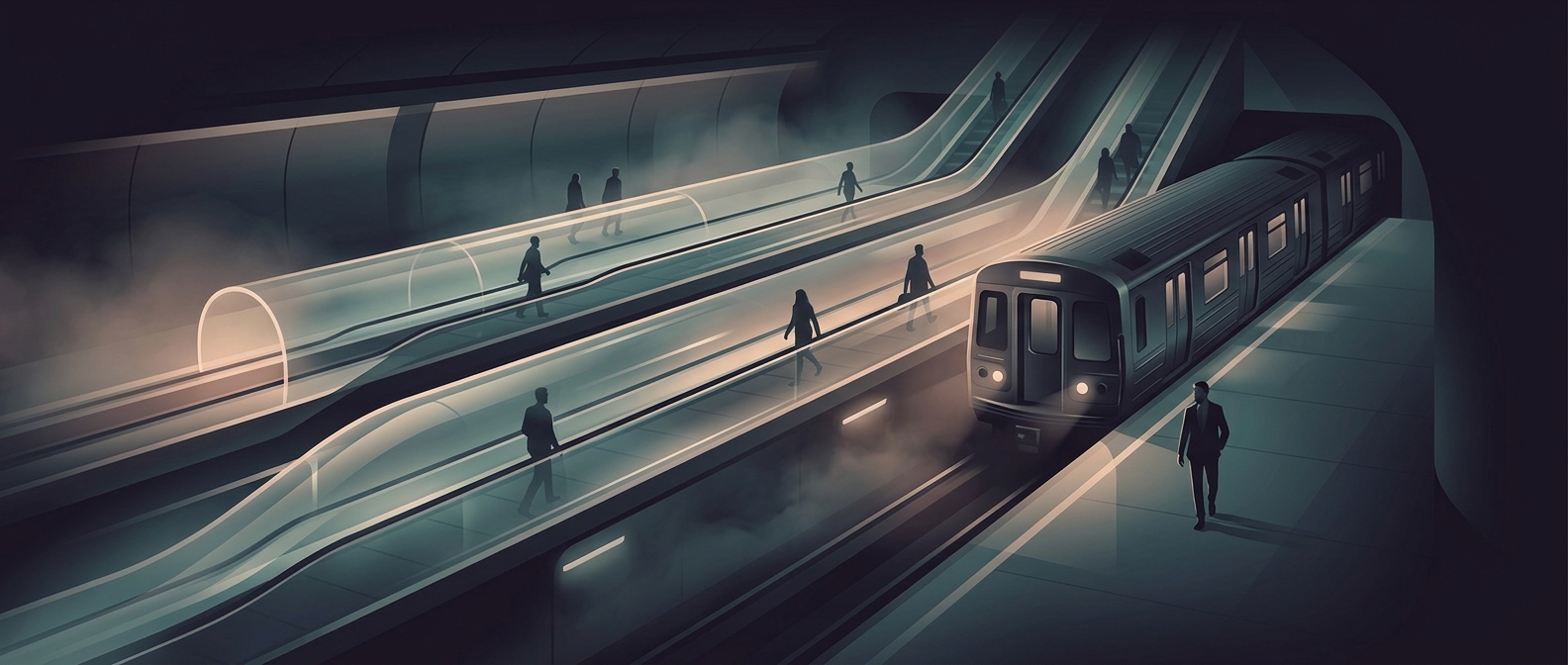
The difficult part is the change of speed
A fast belt could shorten a long station passage, but it cannot simply begin at full speed beside a stationary floor. A passenger stepping onto it would have to absorb the sudden change in motion—and carry luggage, keep balance, and avoid colliding with people ahead.
The key design problem is therefore the transition. One possible approach is to use a series of belts that move progressively faster, so a rider is accelerated in stages rather than asked to leap from a walk to a high speed. At the far end, the sequence would reverse, slowing passengers before they step back onto ordinary flooring. That makes the system less like one unusually fast airport walkway and more like a moving pathway with controlled entry and exit zones.
Speed competes with space and flow
Those transition zones take room. The station would need enough corridor length for passengers to board, accelerate, travel, decelerate, and leave without bunching up. People who cannot or do not want to use the belt—because they are using mobility aids, managing children, or simply prefer to walk—would also need a safe route alongside it.
Capacity matters as much as speed. A belt may move one passenger quickly through a corridor, but if riders hesitate at its entrance or crowd the exit, the bottleneck has merely shifted. The design would have to make boarding predictable and keep fast-moving passengers from running into slower ones.
A faster corridor, not a faster train
The proposal targets the stretch between the street, platforms, and transfers; it does not increase a train’s speed or make trains arrive more often. Its benefit would be felt most in stations where a long walk is part of the trip. But the same corridors that promise the greatest time savings may also be the hardest places to fit acceleration lanes and accessible alternatives. The memorable idea—a subway passage that carries people at speed—depends less on the belt’s top speed than on whether riders can enter and leave it safely.