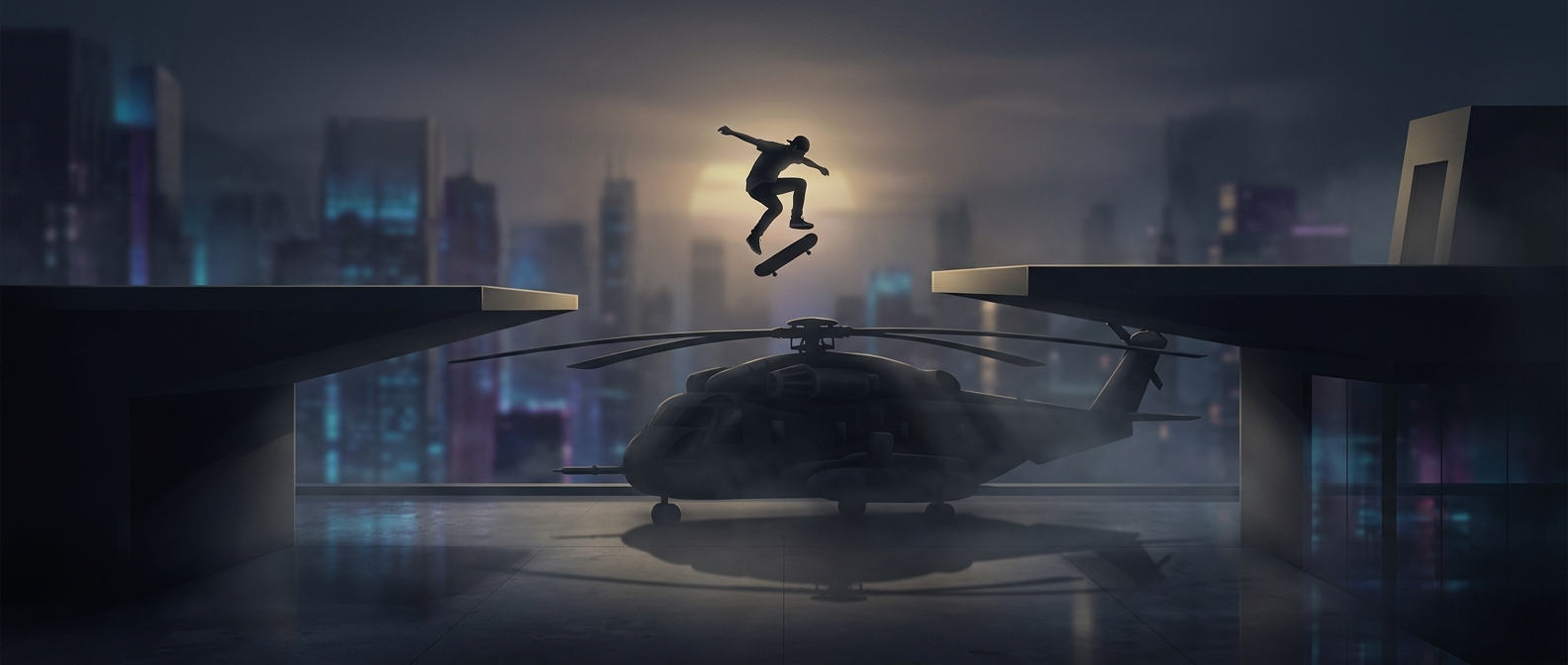
Turning a Hazard Into a Trick Opportunity
A helicopter is dangerous in ordinary life because its blades move fast and leave little room for error. In a skateboarding game, though, it can be made legible as a piece of level geometry: something the player can approach, use to gain height, and clear with a stunt. The machine’s motion supplies spectacle; the game’s simplified rules make that spectacle playable.
That shift changes the player’s question from “How do I avoid this?” to “Can I use it to build a better run?” A launch over the blades becomes a moment to chain tricks together, and the apparent danger raises the drama of landing cleanly. The helicopter is not merely scenery in the background—it helps shape the route and the timing of a run.
Arcade Physics, Not Aviation
The trick works because the game abstracts away the real-world complications. Players do not need to model rotor airflow, aircraft handling, or the consequences of a collision. They need to read a clear obstacle, choose an approach, perform tricks, and keep control well enough to land. That keeps the focus on timing and score rather than technical realism.
It also captures the series’ broader arcade sensibility: unusual objects can become opportunities when the rules reward experimentation. A helicopter can look like a threat and function like a ramp at the same time. The memorable image comes from that mismatch—an ordinary stunt game briefly makes a spinning aircraft part of the course.