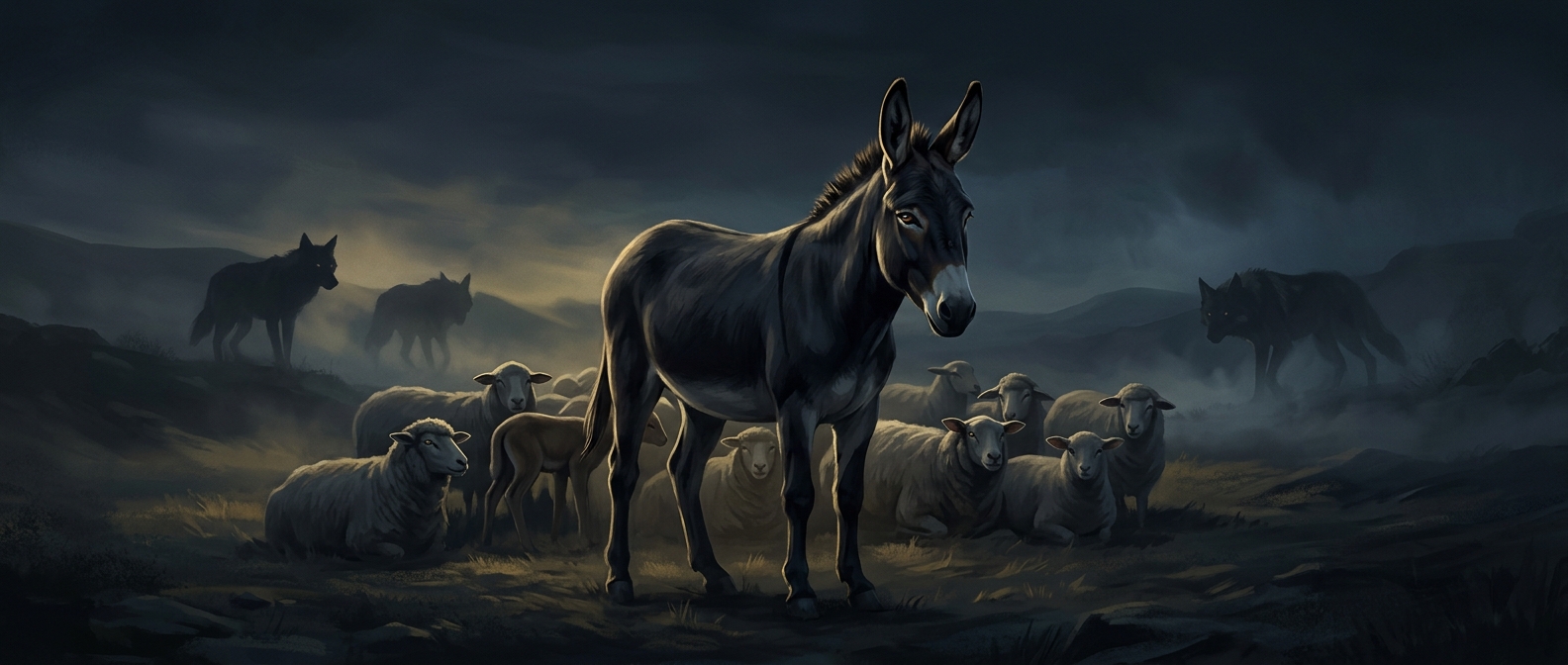
A guard that meets danger head-on
A donkey protects sheep in a different way from a sheepdog. A dog typically moves around the flock and steers it; a guarding donkey is more likely to face an approaching animal directly. If it notices a threat, it may bray, advance, chase, bite, or kick. Its size and willingness to confront an intruder can make a predator reconsider approaching the flock.
Why the arrangement can work
Donkeys are alert and strongly reactive to unfamiliar animals entering their space. When one lives among sheep, it can become familiar with the flock and respond when something approaches. The bray can also draw a farmer’s attention, while the donkey’s movement puts an immediate obstacle between the threat and the sheep.
That makes a donkey less like a shepherd and more like a living deterrent: it does not need to gather scattered sheep to disrupt an attack. Its usefulness depends on the individual animal, the flock, and the predators in the area; a donkey is not guaranteed to confront every threat, and it cannot cover ground or manage sheep as a trained herding dog can.
The tradeoff behind the choice
A donkey can be a practical guardian where sheep share pasture with predators that approach on the ground and can be driven off by a direct confrontation. It is not a substitute for sound fencing, attentive care, or other protections when threats are persistent or come from more than one direction. The memorable part is the role reversal: instead of circling behind the sheep to move them, the donkey plants itself in front of danger.