How Jupiter’s Great Red Spot keeps turning
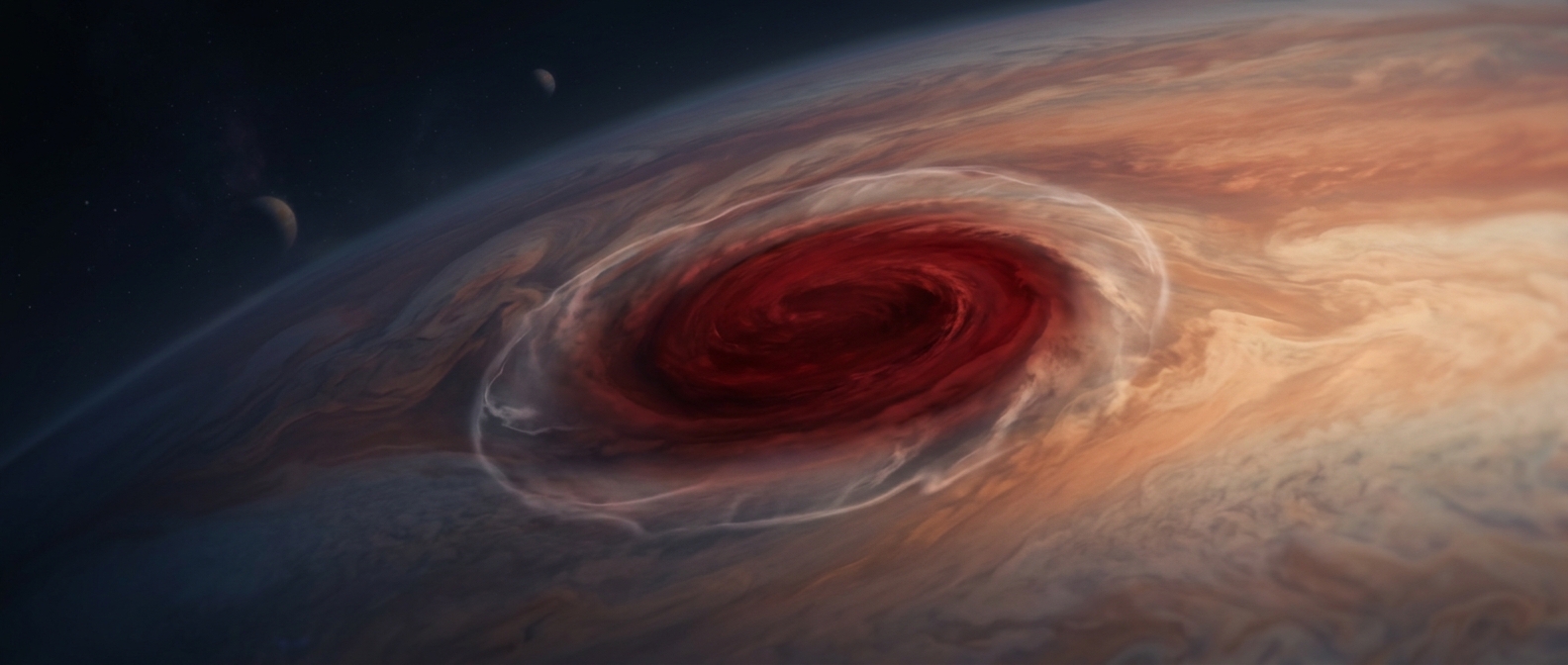
The Great Red Spot is a huge anticyclone: a rotating storm whose winds circle around a region of high pressure. On Earth, anticyclones are usually associated with fair weather. Jupiter’s version is anything but calm. Its clouds trace a vast, turbulent whirlpool, with winds around the storm moving at hundreds of kilometers per hour.
Unlike a hurricane, the Spot has no ocean beneath it and no solid surface to cross. It sits in Jupiter’s deep atmosphere, between powerful bands of wind that blow in opposite directions. Those surrounding jet streams help confine the storm and keep its circulation going, much as flowing currents can shape and sustain a large whirl in water. Jupiter’s internal heat helps drive activity in its atmosphere, but the Spot is not simply a storm powered by that heat like an engine.
A storm that changes size
The Spot has been observed for centuries, though it is not certain that every historical sighting describes the same storm continuously. It has also changed shape and size. In recent decades it has become smaller, and its width is now less than Earth’s diameter—so the familiar image of Earth fitting inside it no longer describes its current scale.
Its persistence is striking because storms on Earth usually weaken when they lose access to the conditions that sustain them. Jupiter’s atmosphere offers a different setting: no land or mountains to disrupt the circulation, and immense, long-lived jet streams that can keep feeding energy into atmospheric motion. The Spot’s changing outline shows that it is not an unchanging eye in the clouds, but a living part of a restless system. Even as it shrinks, it remains large enough to make Earth’s weather systems look small by comparison.