What “darkness” meant to John of the Cross
For the 16th-century Spanish mystic John of the Cross, darkness was both a physical experience and a spiritual image. In his poetry and teaching, it described a period when a person could no longer rely on vivid religious feelings, clear answers, or a sense of God’s closeness. The loss of those comforts, he believed, could loosen the grip of pride and self-interest and deepen a person’s trust in God.
This was not simply a celebration of pain for its own sake. John’s idea was that hardship could become spiritually meaningful when endured in a life directed toward God—not that suffering automatically made someone holy.
A metaphor shaped by real confinement
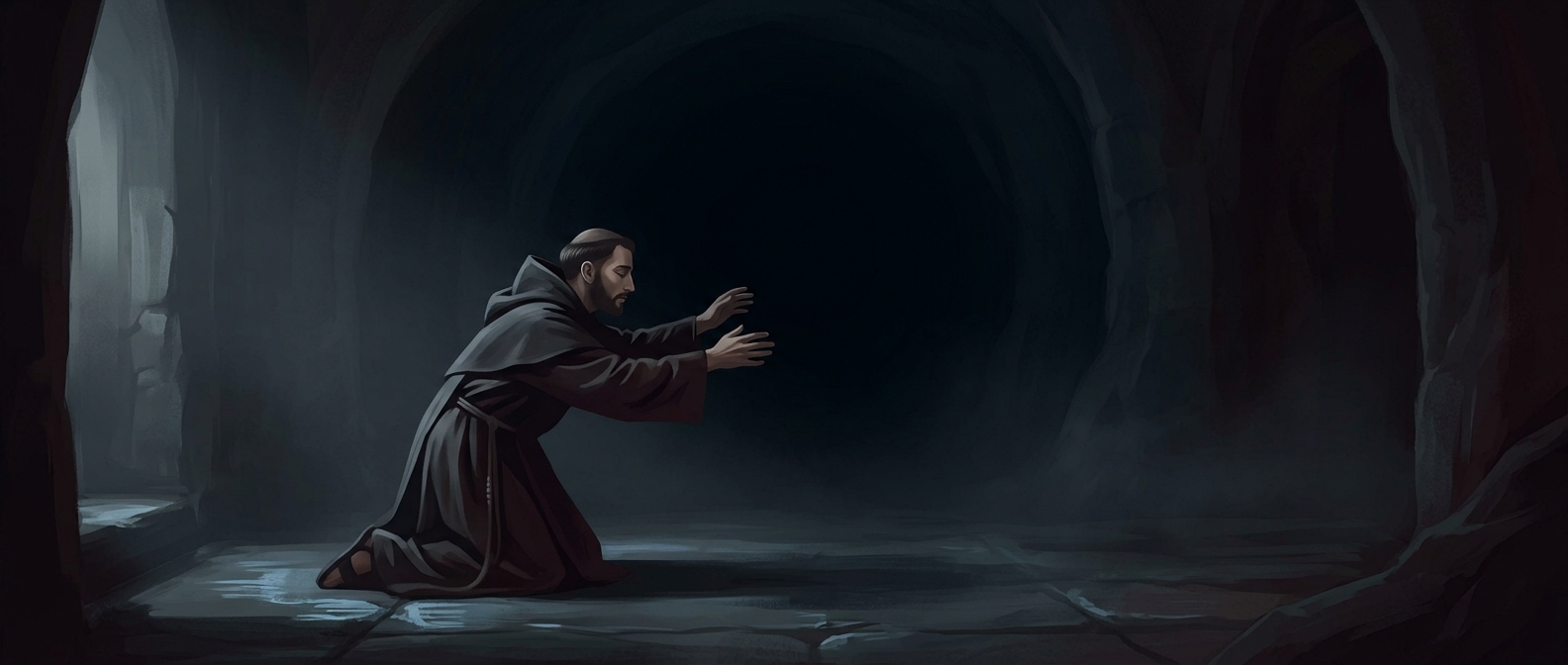
The image had a stark personal setting. In 1577, during a conflict within the Carmelite religious order over reform, John was imprisoned by fellow Carmelites in Toledo. He spent months in a small, dark cell under harsh conditions before escaping. The darkness in his writing therefore belonged to both the language of spiritual experience and the reality of deprivation he had known.
But the two kinds of darkness were not identical. His imprisonment was imposed on him; the “dark night” of his spiritual writings describes an inner passage in which familiar consolations fall away. John used the night not as a simple synonym for despair, but as an image for a difficult process whose purpose might not be apparent while a person was passing through it.
Why the image endured
John’s account gave suffering a demanding interpretation: pain was not proof that God had abandoned a person, nor a shortcut to spiritual achievement. It could be a stripping away of reliance on easy reassurance. That distinction is why the image remains powerful—and why its original religious meaning is more precise than the modern idea of merely “going through a dark time.”