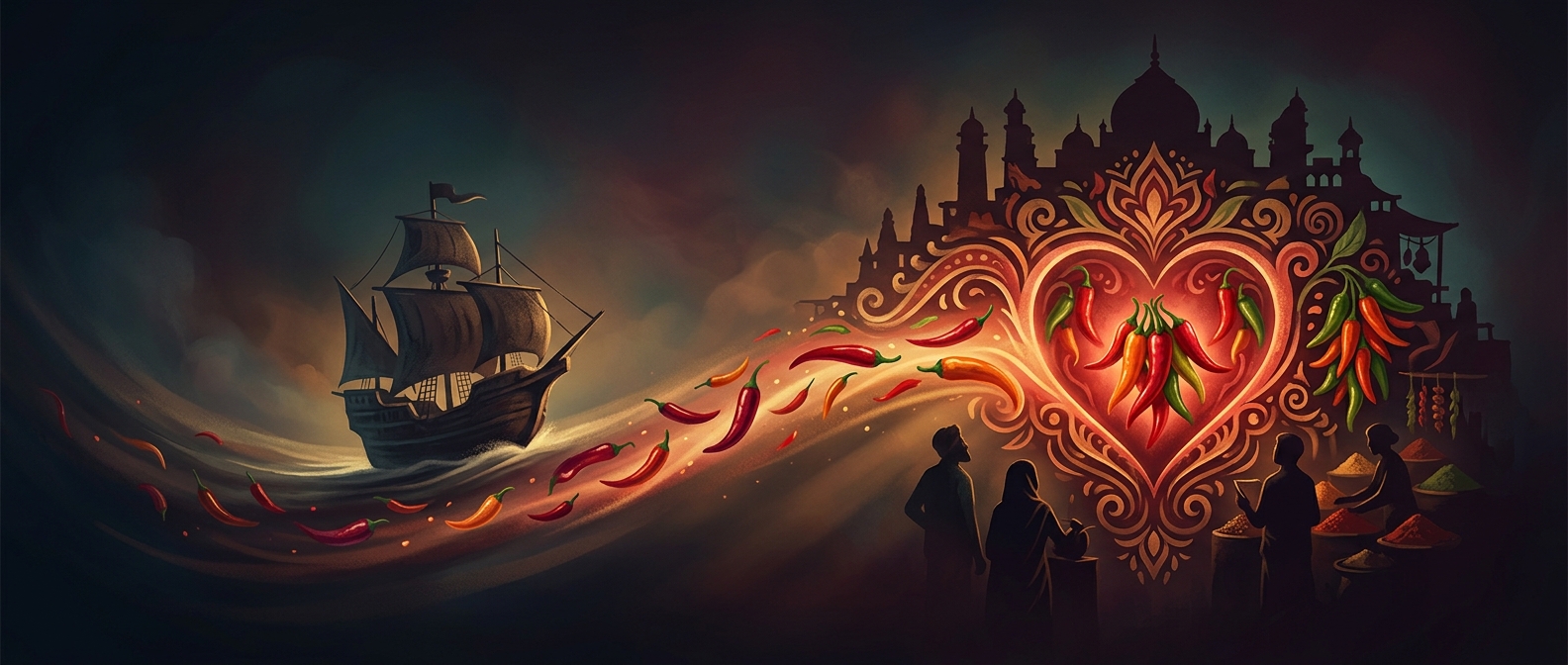
A pepper crossed oceans—and fit local farms
Chili peppers are native to the Americas, but their journey to Asian kitchens began with the Portuguese maritime trade of the 16th century. Ships connected ports across the Indian Ocean, carrying plants and foods as well as more obvious cargo. Peppers could be grown from seed, and in warm climates they were practical crops: a small planting could supply fresh pods without requiring the elaborate processing needed for some traded spices.
That mattered because peppers did not have to remain a luxury arriving by ship. Once seeds reached new ports and inland communities, growers could cultivate them locally. The crop’s portability turned a long-distance introduction into a food that could become commonplace.
Local cooks made the newcomer their own
The pepper’s heat gave cooks a vivid new ingredient, but its spread was not simply a matter of people adopting one foreign dish. Across a vast region, cooks folded peppers into existing ways of preparing food—using them fresh, dried, or ground, and pairing them with familiar ingredients and techniques. The result was not one uniform “Asian” cuisine, but many local uses for a plant that could thrive in different settings.
India became an important early center of cultivation, and peppers later became deeply established in places including China and Thailand. Their sharp heat could enliven a meal in small amounts, while drying and grinding made the crop easier to store and use beyond harvest time. A crop that traveled as a novelty became part of everyday cooking because it could be grown nearby and adapted to local taste.
The lasting consequence
The pepper’s route also shows how trade can change food far beyond the ports where goods first arrive. Portuguese ships brought the plant across an ocean; farmers and cooks, rather than merchants alone, made it durable. Today, chili heat can seem inseparable from many Asian dishes, even though the plant itself came from the other side of the world.