How an invisible part of sunlight showed itself
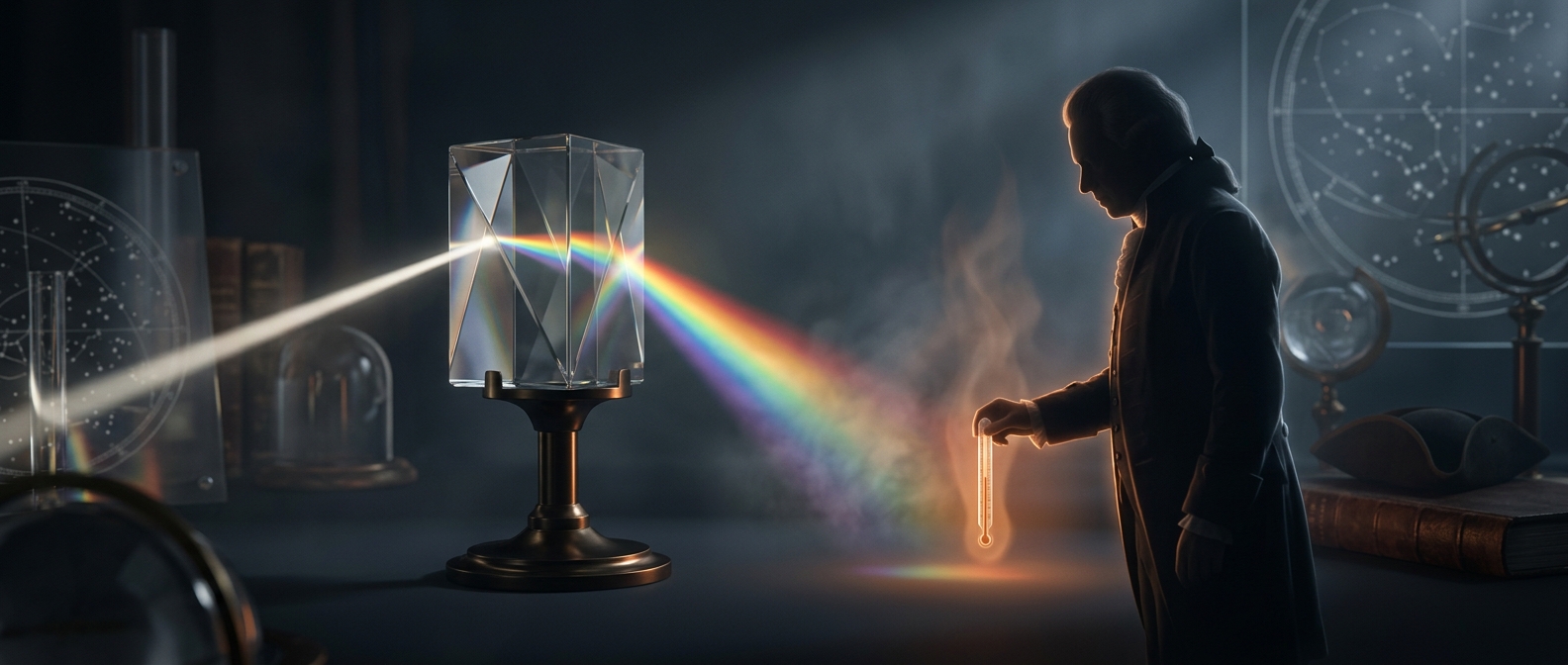
A thermometer responds to a change in temperature, not to color. That made it a useful detector for radiation the eye could not see. When Herschel compared readings across and just beyond the visible spectrum, the warming beyond red suggested that sunlight carried energy outside the range of human vision.
The key distinction is between visible light and infrared as different ranges of the same kind of radiation. A prism separates sunlight by wavelength—the distance between successive waves—so colors appear in order. Infrared has longer wavelengths than red, placing it beyond the eye’s visible range rather than making it a different substance.
From a thermometer to thermal cameras
When infrared radiation is absorbed by an object, its energy can increase the motion of the object’s molecules, raising its temperature. A thermometer registers that warming; a thermal camera uses sensors to detect infrared from surfaces and turns differences in the signal into an image. The camera is not seeing heat itself, but radiation associated with the objects’ temperatures.
Herschel’s result widened the meaning of a “spectrum.” A rainbow is only the part of sunlight people can see; instruments can reveal neighboring wavelengths that eyes miss. That is why a thermal camera can show a warm hand against a cooler background even in darkness: the contrast comes from infrared emitted by the scene, not from visible light.