How a cotton seed grows a coat of fibers
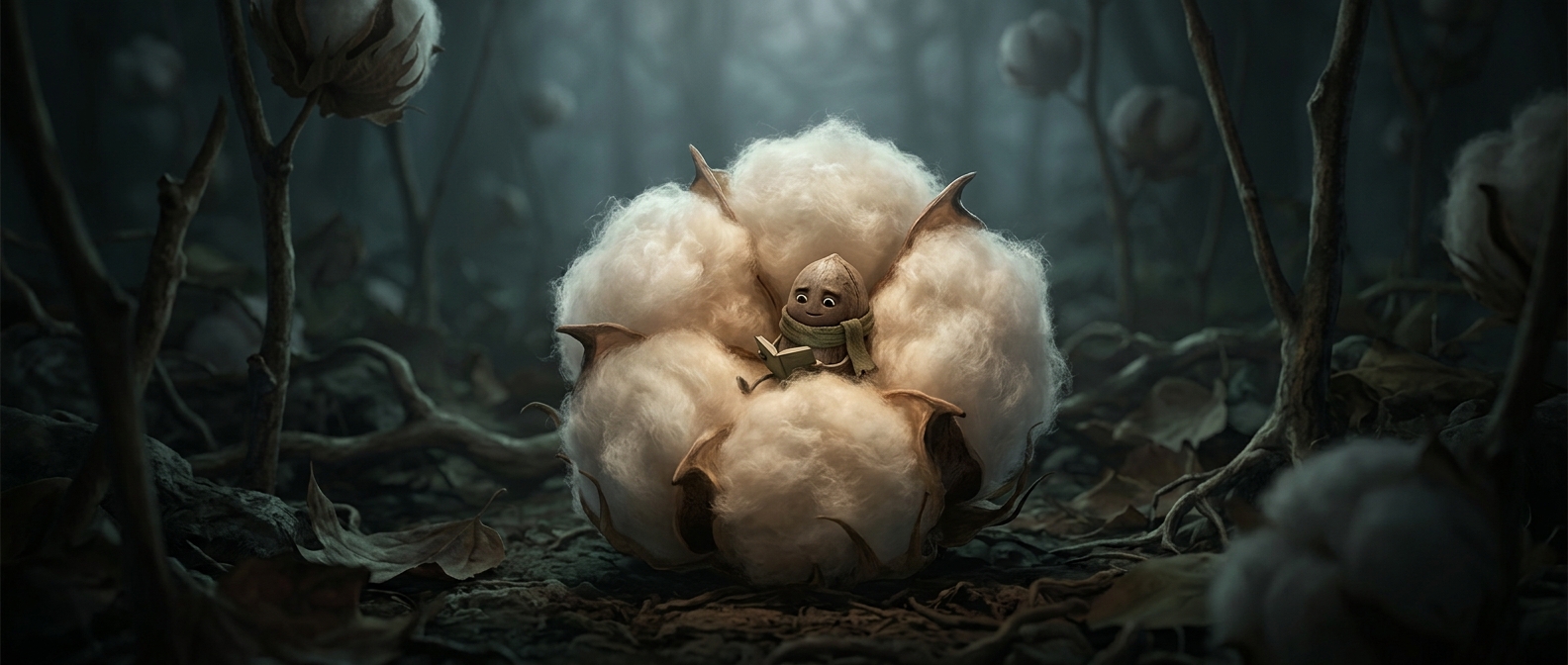
A cotton boll is the plant’s fruit. Inside it, seeds develop alongside thousands of slender hairs called fibers. Each fiber begins as a single cell growing out from the seed’s outer surface—not as a bundle of smaller strands. As that cell elongates, it lays down a tough wall around itself, leaving a narrow hollow interior.
Length and twist make spinning possible
The fibers do not all grow to the same length, but many become long enough to overlap when gathered. Their surfaces also develop a natural, irregular twist as they dry. Together, length and twist let the fibers catch against one another: when a spinner draws them out and twists them, friction helps keep the strands from slipping apart.
This is why cotton can become continuous thread even though each individual fiber is short. Spinning does not fuse the cells; it arranges and twists many fibers into a stronger, usable yarn.
A protective coat that became a material
The fibers form a soft covering around the seeds, helping protect them as the boll matures. When the boll opens, the fluffy mass exposes both seeds and fibers. People separate the seeds from the fibers, then clean and spin the fibers into yarn.
The key transformation happens at two scales: the plant grows each hair as one cell, while spinning turns a mass of those separate cells into thread. A cotton plant, in effect, produces raw material that is already shaped to grip itself when twisted.