How Air Helps an Avalanche Keep Moving
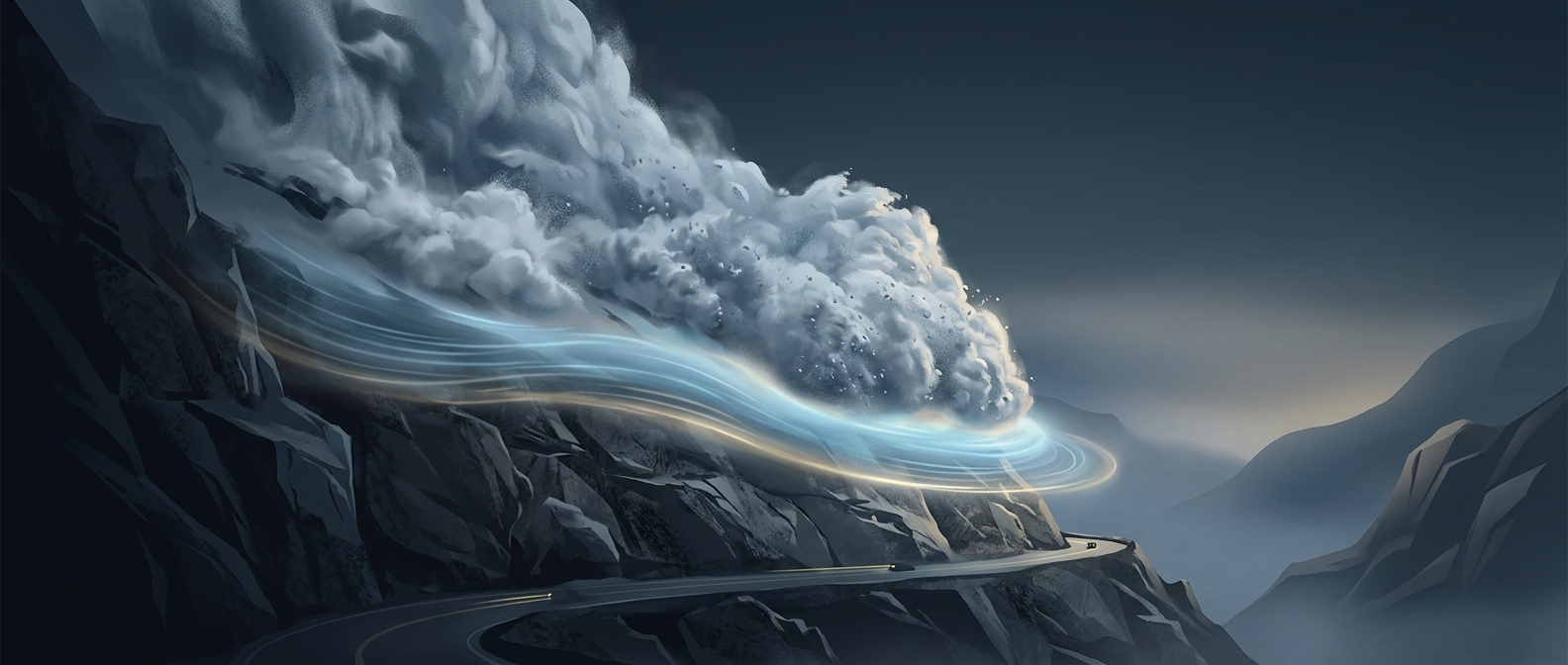
A moving avalanche is not a solid block sliding over a solid slope. Snow breaks into grains and clumps that collide, roll, and shear past one another. In a fast, powder-rich avalanche, some of the air caught among those particles is compressed near the ground. The resulting pressure can help support the moving snow and reduce how hard its grains press against the surface.
That matters because friction depends partly on how forcefully surfaces press together. Ease that pressure, even briefly, and the snow is less likely to lose momentum at rough patches or shallow obstacles. Air moving through the snow also helps keep particles agitated rather than packed into a rigid mass.
A Cushion, Not a Hovercraft
The effect is not a sealed pocket of air holding the whole avalanche aloft. Snow is porous, so air can leak through it, and the flow varies across the moving mass. The pressure cushion is most relevant in fast, turbulent avalanches with lots of suspended, powdery snow; it is not a simple explanation for every snow slide.
A powder avalanche can therefore behave partly like a flowing mixture of snow and air, while its denser lower portion still interacts with the ground. The air does not make the slope smooth. It helps the snow maintain motion over ground that is anything but smooth—which is one reason a seemingly soft cloud of snow can travel far beyond the steep slope where it began.