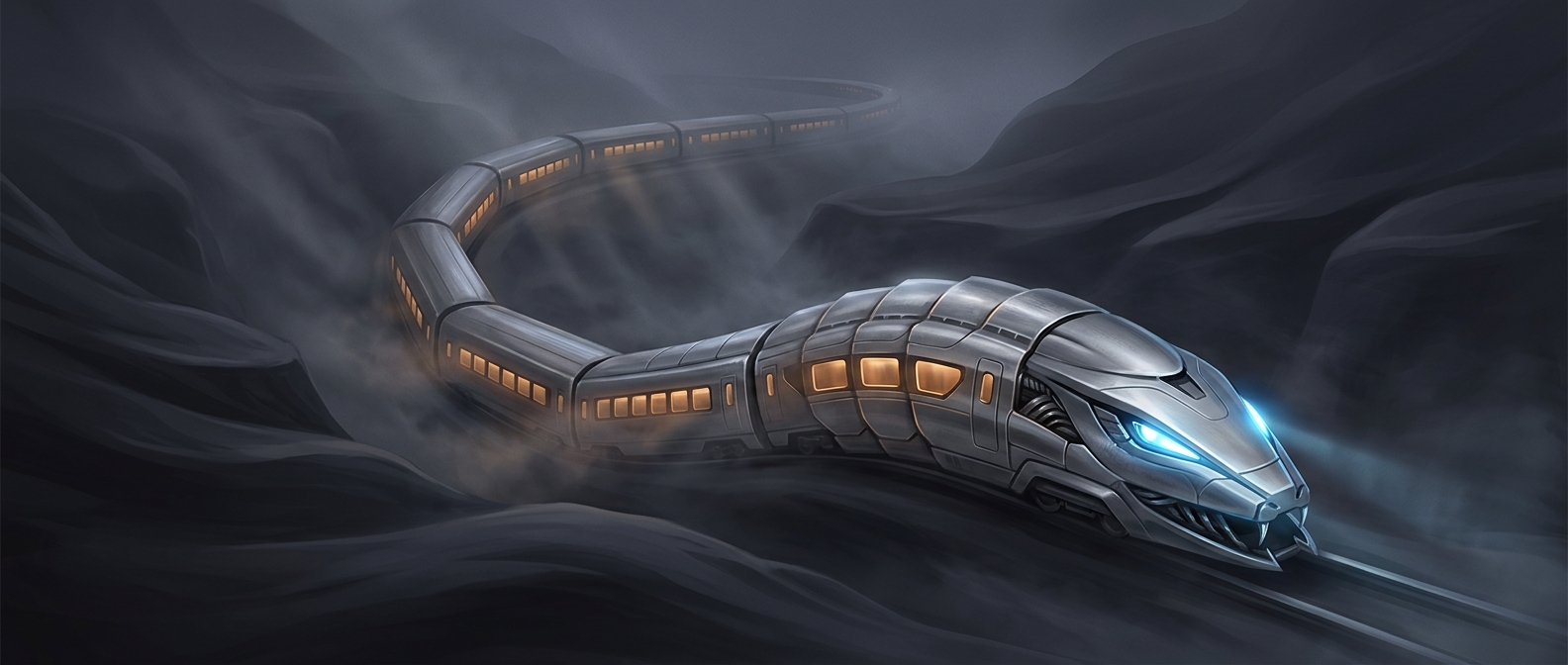
Why a train can turn without bending its cars
A railcar’s wheels are mounted on a bogie—a wheeled frame that can swivel beneath the car. As the track curves, the bogie turns to align its wheelsets with the rails, while the car body remains mostly straight. This lets a long vehicle negotiate a bend without requiring every wheel to point in exactly the same direction.
The couplings between cars have a different job: they connect the vehicles while allowing limited movement as the train stretches, compresses, and changes direction. They are flexible enough to accommodate a curve, but not loose enough for cars to wander freely. The rails guide the wheels, and the couplings keep the cars connected as the train follows that path.
A curve is a chain of small adjustments
A train does not pivot around one central point like a bus. Each bogie turns beneath its own car, and each coupling takes up the changing angle between neighboring cars. On a curve, the cars therefore point in slightly different directions, with the angle generally more noticeable on tighter bends.
That arrangement balances two needs: cars must move enough to follow the track, yet remain aligned and securely linked. It is why a long train can snake around a bend while its individual cars stay rigid—and why the sharpest curves impose limits on how trains and their routes can be designed.