From palace consort to the throne
Wu Zetian’s rise began inside the Tang imperial household, where access to the ruler could become access to political power. She entered the palace as a concubine of Emperor Taizong. After his death, she was sent to a Buddhist convent, as was customary for some of his former consorts. Taizong’s son and successor, Gaozong, later brought her back to court; she became his empress and an increasingly influential political partner.
When Gaozong’s health weakened, Wu took on a larger role in governing. After his death, she continued to wield power through their sons, who succeeded him. The court’s changing occupants did not dislodge her: in 690, she took the throne herself and proclaimed the Zhou dynasty.
Why her title mattered
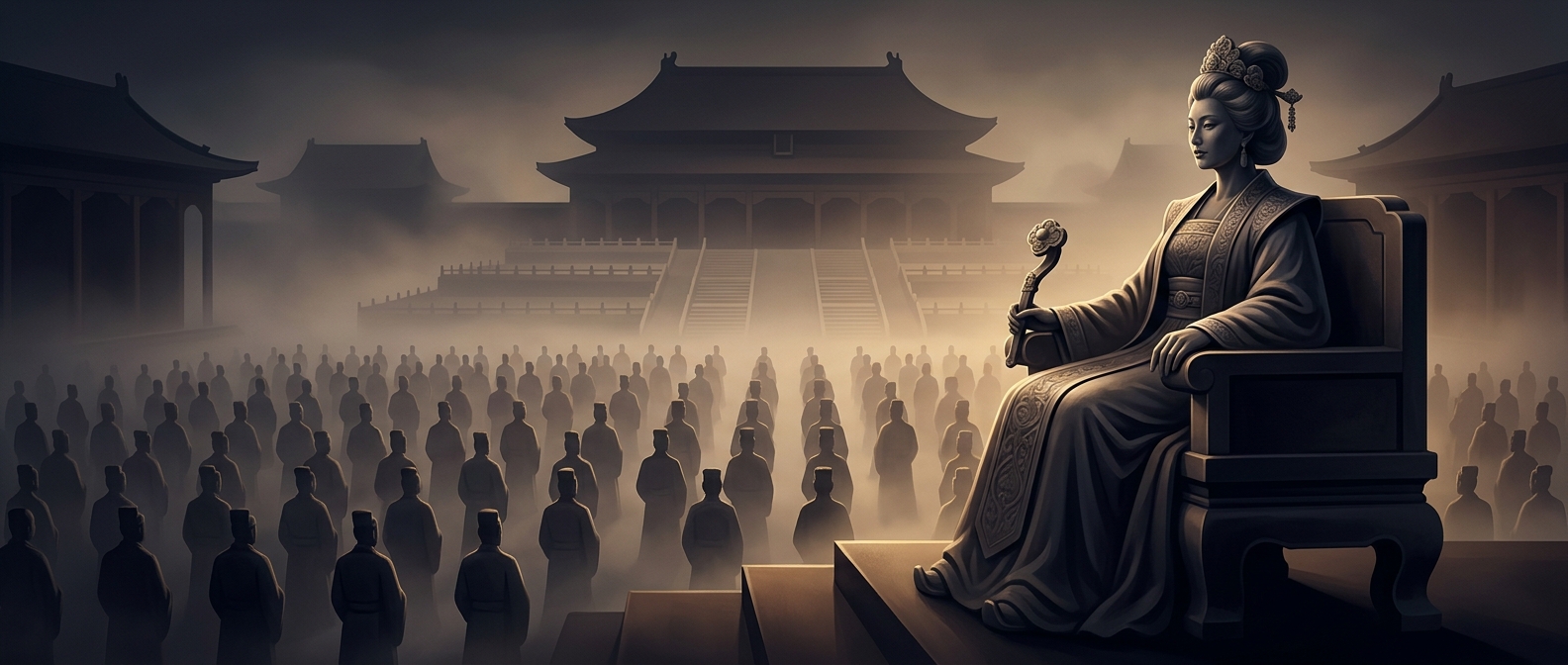
An empress consort was a ruler’s wife. Wu went further: she claimed the title huangdi, the Chinese title used by emperors, and ruled in her own name. That distinction made her the only woman in Chinese history officially recognized as emperor. Her challenge was not simply to control the palace, but to present her rule as legitimate in a political order built around male succession.
She governed for about fifteen years, and her Zhou dynasty interrupted Tang rule. After her death, the Tang dynasty was restored. The episode shows how a change of dynasty could begin not with an invading army, but with a powerful figure already inside the imperial family—and how firmly the government could remain in her hands even as the throne passed among her sons.