How Schlieren Imaging Turns Heat Into Contrast
A candle’s rising plume is made of air, not smoke: warmer air expands, becomes less dense, and rises while cooler air moves in to replace it. The boundary between these moving layers is uneven and constantly shifting. Because air’s refractive index—the measure of how much it bends light—changes with temperature and density, light passing through the plume is nudged off course.
The camera does not photograph the air directly. It records how the air redirects light.
The Knife Edge Makes Small Deflections Visible
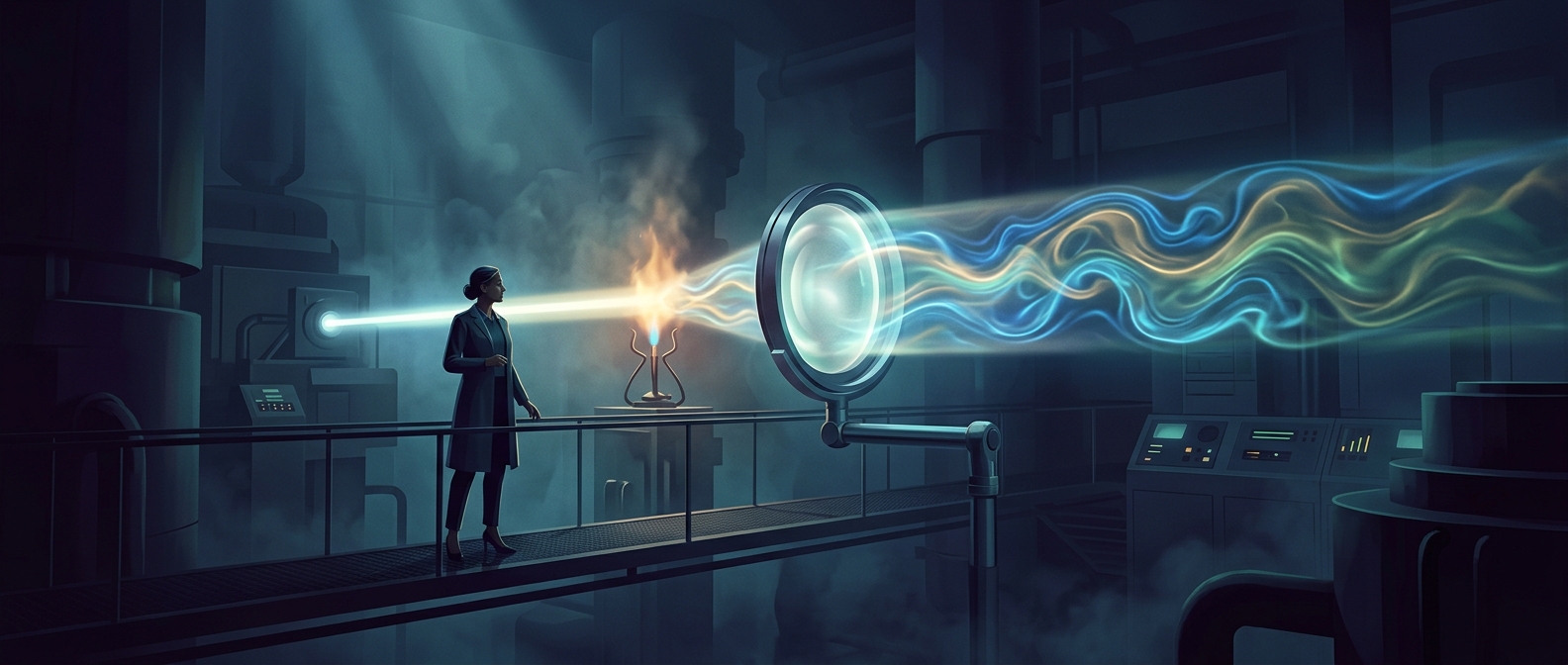
In a typical Schlieren setup, a light source and curved mirrors send a broad, nearly parallel beam through the air being observed. A knife edge sits near the point where the beam is focused before the light reaches the camera. It blocks part of that beam, leaving the image deliberately dim.
When a passing ray is bent slightly by a temperature difference, it may miss the knife edge—or be pushed farther behind it. That changes how much light reaches a particular part of the camera’s sensor. The result is a pattern of light and dark areas that traces changes in the air’s density. The edge’s position determines which direction of bending produces brightness and which produces darkness.
A Picture of Gradients, Not Air Particles
Schlieren images are most sensitive to how quickly refractive index changes across the viewing path, rather than to temperature itself. A smooth region may produce little contrast, while a sharp boundary can stand out. The familiar wavering above a flame is therefore an optical map of changing air, not a literal outline of a stream.
The same principle can reveal otherwise invisible flows around objects, including warm exhaust or air pushed by a moving body. A candle is a simple demonstration of a broader trick: make tiny changes in a beam’s direction alter whether that light passes a carefully placed edge.