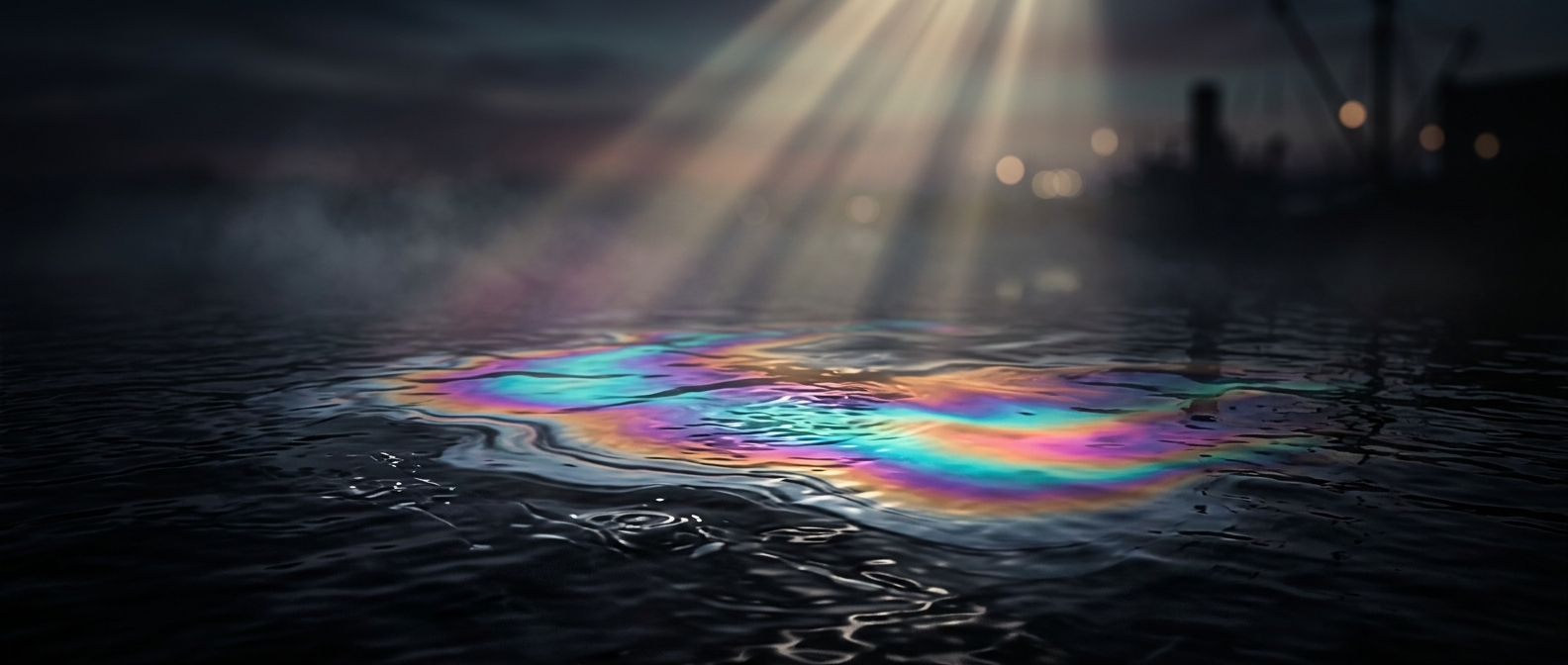
Why a Soap Bubble Shimmers in Bands of Color
A bubble’s film is only a thin layer of water held between air on both sides. When white light hits it, some light reflects from the film’s outer surface and some travels through the water before reflecting from the inner surface. The two reflected waves then meet.
Light behaves like a wave, so the reflections can either reinforce one another or partly cancel. The outer reflection flips the wave’s phase—like turning a wave crest into a trough—while the inner reflection does not. The extra distance traveled through the film adds another shift. Together, those effects determine which wavelengths, or colors, are bright in the reflected light and which are suppressed.
A Moving Map of Film Thickness
The result depends on how thick the film is. A tiny change in thickness alters the distance the second reflection travels, changing which colors reinforce. Because the film is not equally thick everywhere, different patches show different colors at once. As gravity pulls water downward and evaporation thins the film, those patches shift and slide.
The viewing angle matters too: light crossing the film at an angle takes a different effective path than light arriving straight on, so the colors can change as a bubble turns or the observer moves. When a patch becomes extremely thin, reflected waves can cancel across much of the visible spectrum, leaving it nearly black. That dark area is a warning that the film is close to breaking—not a spot where the soap has lost its color.